
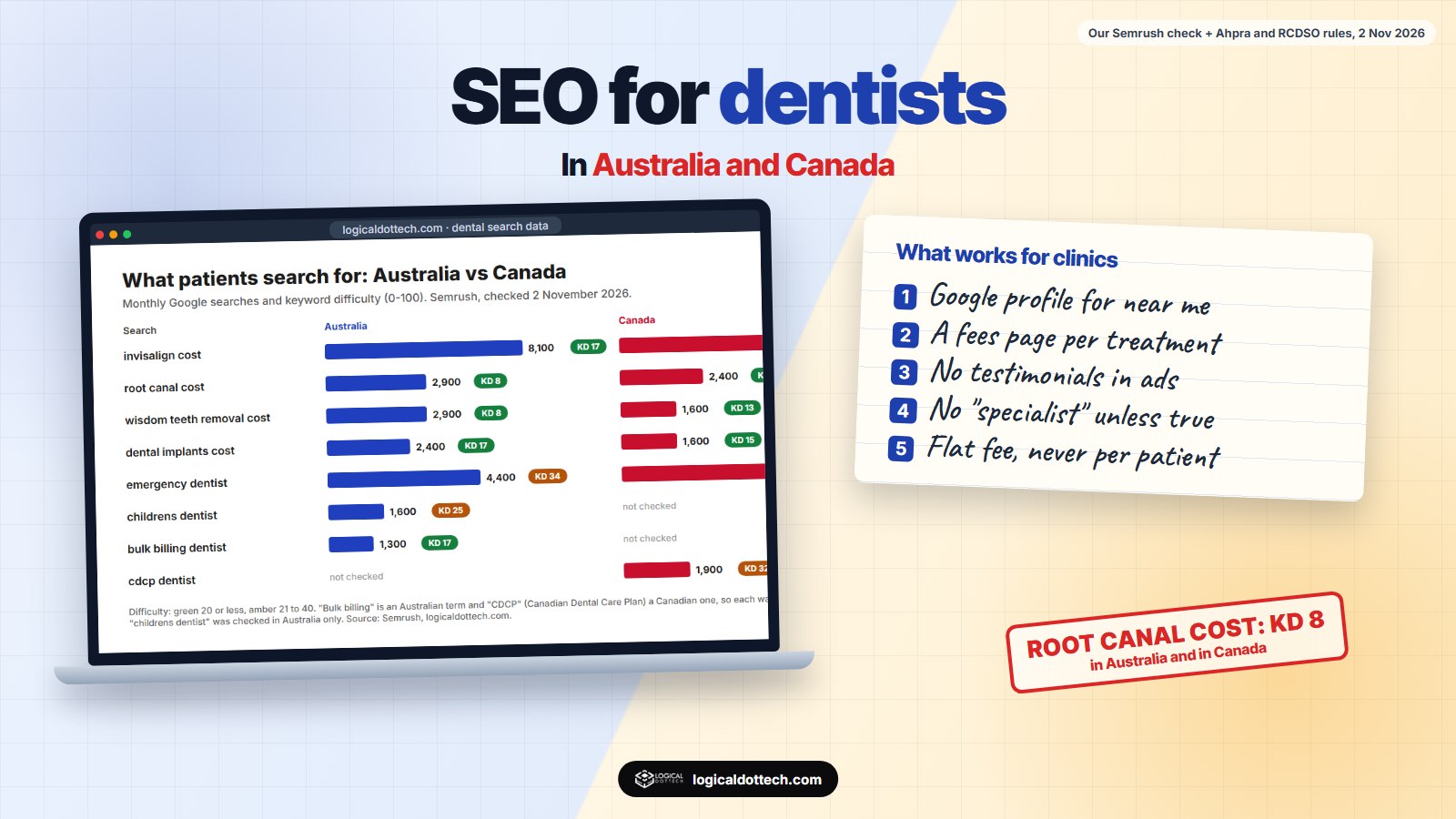
Short answer: SEO for dentists in Australia and Canada starts with two things: a complete Google Business Profile for “dentist near me” searches, and a page for each treatment that explains fees clearly. In our 2 November 2026 check, treatment cost searches were the easiest to rank for in both countries: “root canal cost” had a difficulty of 8 in each, and “invisalign cost” had 8,100 searches a month in Australia. Both countries limit testimonials in dental advertising, so let patients review you on Google but do not copy clinical reviews into your website or ads.
We work with healthcare clients and have teams in Adelaide and Toronto, so we looked at both markets side by side. On 2 November 2026 we pulled search data for 20 dental searches in Australia and Canada and read the advertising rules from Ahpra in Australia and the Royal College of Dental Surgeons of Ontario. This is what a dental clinic in either country should build, and what to avoid.
What do patients search for?
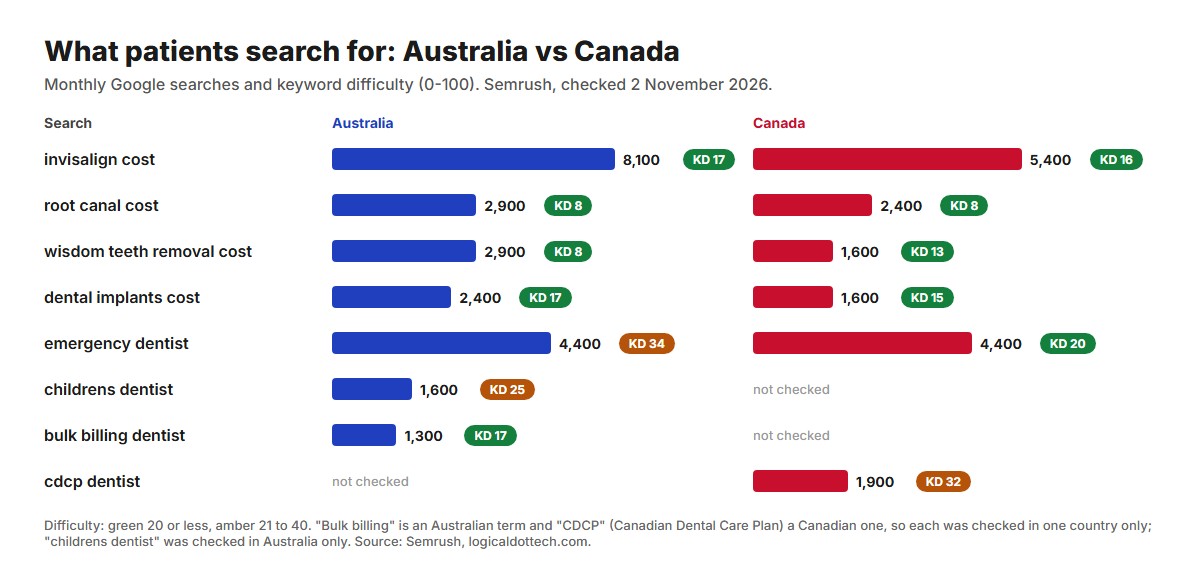
Three things stand out:
- “Dentist near me” is huge in both countries: 60,500 searches a month in Australia and 90,500 in Canada. Google shows Maps results first for these, so the Google Business Profile does most of the work.
- Cost searches are easy. “Root canal cost” (difficulty 8 in both countries), “wisdom teeth removal cost” (8 in Australia, 13 in Canada), “dental implants cost” (15 to 17) and “invisalign cost” (16 to 17) are all low difficulty.
- Each country has its own terms. “Bulk billing dentist” gets 1,300 searches a month in Australia; “CDCP dentist”, for the Canadian Dental Care Plan, gets 1,900 in Canada.
Build a fees page for each treatment
People searching “root canal cost” want a straight answer. A page that explains the treatment and its fees in plain words can rank, because few clinics write one. Ahpra’s guidelines warn against price information that is “unclear, inexact or vague”, and against showing an instalment amount without the total cost. So each fees page should include:
On a fees page
- What the treatment is and who it is for, in plain words.
- Your fee or fee range, and exactly what it includes.
- What can change the price, such as the tooth or number of visits.
- The total cost when you mention payment plans.
- Health fund or insurance notes, stated plainly.
- That a consultation is needed before a firm quote.
Avoid
✗ A low “from” price that almost no patient pays.
✗ “Free” offers with conditions hidden elsewhere.
✗ Promises about results.
✗ Before-and-after photos without checking your regulator’s rules first.
Reviews and testimonials: the rules differ from other businesses
Australia. Section 133 of the National Law, quoted in the Ahpra advertising guidelines, says a person must not advertise a regulated health service in a way that “uses testimonials or purported testimonials about the service or business”. Ahpra adds that this “does not affect” patients posting reviews on review platforms, and that comments about customer service or communication, without clinical content, are not testimonials. The problem starts when a clinic uses reviews to promote itself, for example by copying clinical reviews onto its website or into ads.
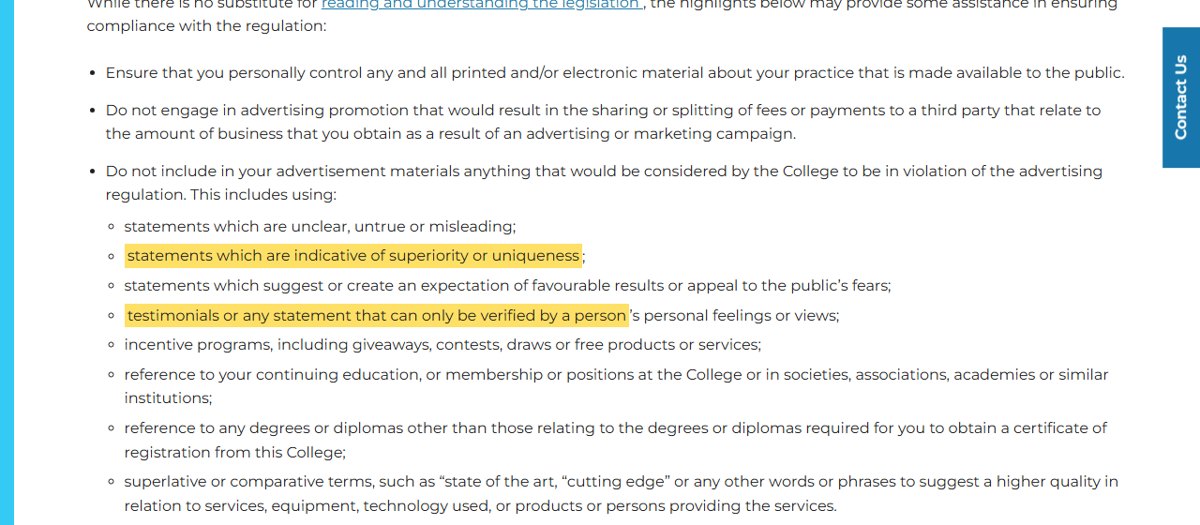
Ontario. The RCDSO lists what dental advertising must not include. Among them: statements “indicative of superiority or uniqueness”, “testimonials or any statement that can only be verified by a person’s personal feelings or views”, statements that create “an expectation of favourable results”, incentive programs including giveaways and free services, and superlatives such as “state of the art” and “cutting edge”. Dentists in other provinces should read their own college’s rules.
In practice, in both countries: let patients review you on Google, reply to every review without mentioning anyone’s treatment, and keep clinical reviews off your own website and ads. Our article on Google reviews for doctors has examples of safe replies that work for dentists too.
Words to be careful with
| Word or claim | Australia (Ahpra) | Ontario (RCDSO) |
|---|---|---|
| “Specialist”, “specialises in” | Likely to mislead without specialist registration; “substantial experience in” is less likely to | Ads that mention a procedure must say whether you are a general practitioner or a specialist |
| Testimonials in ads or on your site | Not allowed in advertising (section 133); patient reviews on review platforms are not affected | Not allowed |
| “Free” check-up or whitening | “Free” must mean absolutely free, with terms stated in the ad | Incentive programs and free services not allowed |
| Payment plans | State the total cost whenever you show an instalment amount | Not named in the RCDSO list we read; keep fees clear |
The RCDSO list also names superiority claims, superlatives such as “state of the art” and “cutting edge”, and statements that create an expectation of favourable results. Even where a rule does not name a word, claims you cannot prove are a risk in any country.
The Google Business Profile for a dental clinic
- The most specific primary category, usually “Dentist”, plus extra categories only for services you really offer.
- A profile for each public-facing dentist if several work at the clinic, as Google’s practitioner rules allow, alongside the clinic profile.
- Accurate hours, and emergency hours if you take emergency patients. “Emergency dentist” gets 4,400 searches a month in each country.
- Each treatment listed as a service, linked to its fees page.
- Photos of the clinic, equipment and team. No patients.
- Say what you accept: bulk billing or health funds in Australia; insurance and whether you see CDCP patients in Canada.
How a dental marketing agency should work
Two lines from the regulators matter when you hire help. Ahpra says advertisers are responsible for their advertising, including content produced by others on their behalf, so the dentist should approve every page and post. The RCDSO tells Ontario dentists not to engage in advertising that would result in sharing or splitting fees with a third party based on the business a campaign brings in. A flat monthly fee, with no payment per new patient, keeps both sides clear.
That is how we work. We build factual dental websites with a fees page per treatment, set up the Google Business Profile, and send every page to the dentist for approval. See our healthcare SEO service. In Australia, message us on WhatsApp on 0494 866 992 or see our Australian page; in Canada, call +1 437-563-8080 or see our Toronto page.
Common questions
What is the best SEO for a dental clinic?
A complete Google Business Profile for “dentist near me” searches, plus a page for each treatment with clear fee information. In our 2 November 2026 check, “root canal cost” had a keyword difficulty of 8 in both Australia and Canada, and “invisalign cost” had 8,100 searches a month in Australia at difficulty 17.
Can dentists use patient testimonials in Australia?
Not in advertising. Section 133 of the National Law says a regulated health service must not be advertised in a way that “uses testimonials or purported testimonials”. Ahpra says this does not stop patients posting reviews on review platforms, and comments about customer service without clinical content are not testimonials. Do not copy clinical reviews into your website or ads.
Can dentists in Ontario use testimonials?
The Royal College of Dental Surgeons of Ontario lists “testimonials or any statement that can only be verified by a person’s personal feelings or views” among the things dental advertising must not use, along with superiority claims and incentive programs. Dentists in other provinces should check their own regulator.
Can a dentist say “specialist” on their website?
In Australia, only with specialist registration; Ahpra says words like “specialist” or “specialises in” are otherwise likely to mislead, while “substantial experience in” is less likely to. In Ontario, the RCDSO says ads that mention a procedure must disclose whether you are registered as a general practitioner or a specialist.
Should a dental website show prices?
Fee pages answer the searches with the least competition, so they are worth having if you can state fees clearly. Ahpra warns against unclear or vague price information and against showing an instalment amount without the total cost. Explain what is included and what can change the price.
Can a marketing agency be paid per new patient?
Be careful. The RCDSO tells Ontario dentists not to engage in advertising that results in sharing or splitting fees with a third party based on the business a campaign brings in. A flat monthly fee avoids the problem. Ahpra also says advertisers are responsible for content others produce on their behalf.
Data: our own Semrush keyword check for Australia and Canada, 20 dental searches, 2 November 2026. Sources read 2 November 2026: Ahpra, Guidelines for advertising a regulated health service and RCDSO, Advertising Guidelines. Other Canadian provinces have their own dental regulators. This article is general information, not legal advice; check with your regulator or indemnity insurer.