
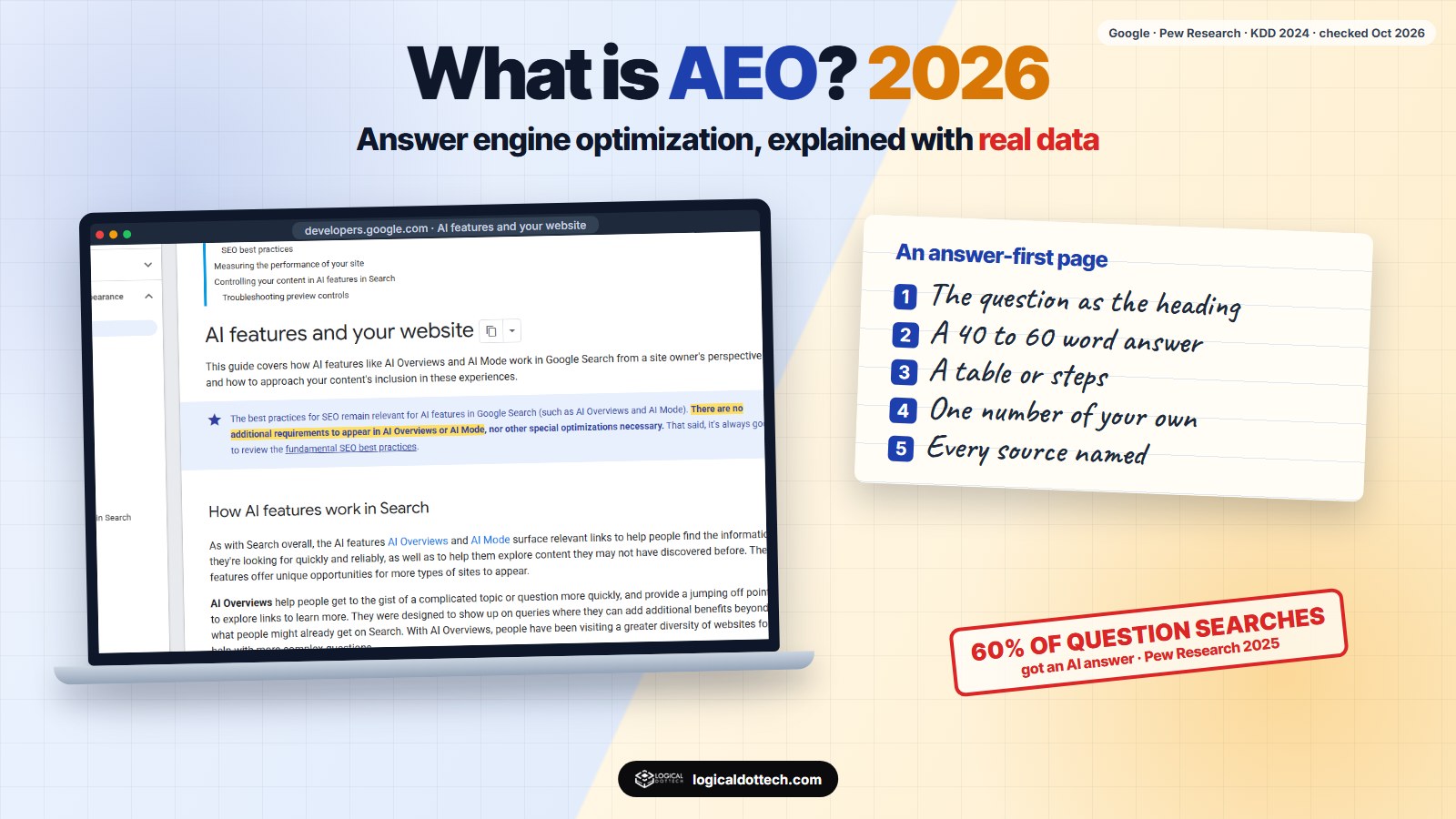
Short answer: AEO (answer engine optimization) means setting up your pages so Google, ChatGPT and other assistants can take a direct answer from them and name you as the source. It is not a separate trick. Google says there are no special requirements for AI Overviews beyond normal SEO, so AEO is good SEO plus pages written answer-first: a clear question, a 40 to 60 word answer, then the detail.
We are an agency that sells AEO, so we have a reason to make it sound complicated. This guide does the opposite. It uses Google’s own documentation, a Pew Research study of 68,879 real searches, a peer-reviewed paper on AI answers, and our own Search Console data, all checked on 19 October 2026.
AEO, SEO and GEO at a glance
| SEO | AEO | GEO | |
|---|---|---|---|
| Goal | Rank in the list of results | Be the answer shown on the page | Be cited in an AI-written answer |
| Where it shows | Blue links | Featured snippets, People Also Ask, voice answers, AI Overviews | ChatGPT, Perplexity, Gemini, AI Overviews, AI Mode |
| Main work | Content, links, technical fixes | Question headings, short direct answers, tables and lists | Facts, numbers and named sources an AI can quote |
| How to measure | Positions and clicks in Search Console | Question queries in Search Console | Referrals from chatgpt.com and perplexity.ai, brand mentions |
All three sit on the same base. If Google cannot crawl and index a page, it will not appear as a blue link, a snippet or an AI source.
What is answer engine optimization?
An answer engine is any search tool that replies with an answer instead of only a list of links. Google’s featured snippets were the first common example. Today it also means AI Overviews and AI Mode in Google, ChatGPT search, Perplexity, Gemini, and voice assistants that read out one answer.
AEO is the work of making your page the one they pick. In practice that means three things:
- Ask the question the way people search it. Use it as the heading, for example “How much does a website cost in India?”, not “Our pricing philosophy”.
- Answer it straight away. Put a complete answer of 40 to 60 words right under the heading, before any background.
- Back it up. Add the detail, a table or steps, a number of your own, and a named source for every claim.
Why does AEO matter in 2026?
Because more searches now end on the results page. Pew Research Center tracked 900 U.S. adults and 68,879 of their Google searches in March 2025. When an AI summary appeared, people clicked a normal result in 8% of visits, against 15% when there was no summary. They clicked a link inside the AI summary in only about 1% of visits, and they ended their browsing session 26% of the time, against 16% without a summary.
The same study shows which searches get AI answers. Overall, 18% of searches produced one. For searches that started with a question word such as what, how or why, it was 60%.
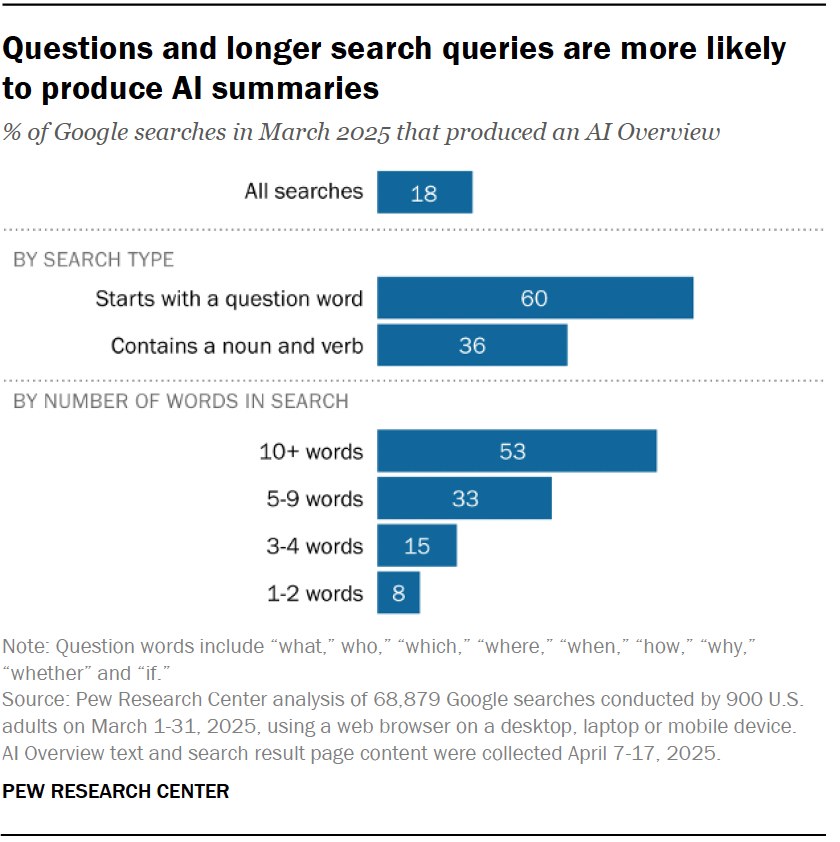
So the searches where a buyer is asking a real question are the ones where the AI answer sits on top. If your page is not the source of that answer, the buyer may never scroll down to your link. This data is from the U.S.; we have not seen an Indian study of the same size yet.
What does Google say about ranking in AI Overviews?
This is the part most AEO sales pages leave out. Google’s guide to AI features, last updated December 2025, says it directly:
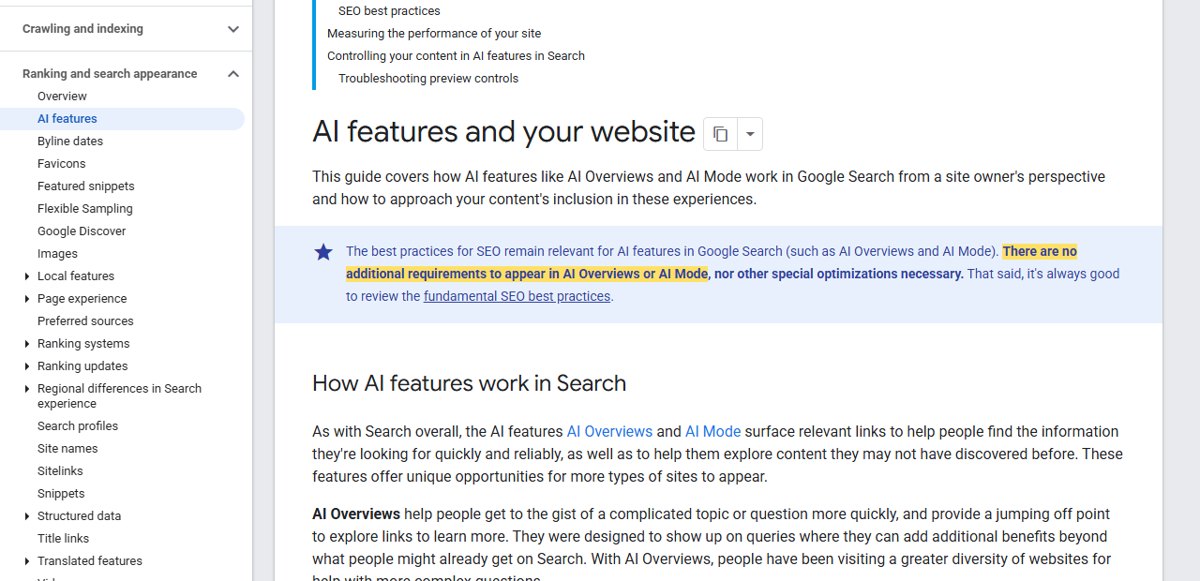
The same page adds four points worth knowing:
- To be a supporting link, a page has to be indexed and eligible to show in Google with a snippet. No other technical requirement applies.
- You do not need new machine-readable files, AI text files or special schema.org markup.
- Structured data should match the text people can see on the page.
- AI Overviews and AI Mode may run several related searches in the background (Google calls it “query fan-out”), so a page that answers the follow-up questions too has more ways in.
One more change from this year: Google stopped showing FAQ rich results on 7 May 2026. Adding FAQ schema will no longer give you the drop-down questions under your result. The questions and answers on the page still matter, because that is the text answer engines read.
What does the research say works for AI answers?
The best public test so far is the GEO paper by Pranjal Aggarwal and five co-authors, presented at the KDD 2024 conference. They rewrote web pages in different ways and measured how much of each page an AI answer used. Compared with the original page:
| Change made to the page | Visibility in AI answers |
|---|---|
| Adding quotations from relevant sources | About 41% higher |
| Adding statistics | About 31% higher |
| Making the text read more fluently | About 28% higher |
| Citing sources | About 27% higher |
| Keyword stuffing | Lower than doing nothing |
The finding that matters most for a small business: the gains were biggest for pages that were not already on top. For the source ranked fifth, citing sources raised visibility by 115%, while for the source ranked first it went down. The paper says this kind of work “is especially helpful for lower ranked websites”. This was measured on the researchers’ own test engine, not on Google, so treat the exact percentages as a guide, not a promise.
Does AEO actually work? Our own data
Our site, logicaldottech.com, is small and new to most of these topics. We write every service page answer-first, with a short answer box at the top. Here are question-style searches where Google showed one of our pages in the top 10, from our Search Console for 18 July to 16 October 2026:
| Search | Our average position |
|---|---|
| what’s a good seo agency for a wordpress website? | 1 |
| what are custom ai models for customer service and who offers them? | 1 |
| what service focuses on optimizing brands for answer engines? | 6 |
| top ai seo / answer engine optimization companies in india | 7 |
| who provides answer engine optimization services? | 10 |
To be honest about the size of this: each of these had between one and three impressions, and none brought a click. Long, chat-like questions are the kind people now type into AI Mode, and they are exactly where a small site can show up early. For the short, competitive search “aeo services” we were still around position 29 in the same period.
The clearest proof came from a client. In a Google review on 14 October 2026, Gurjinder Singh wrote that he found us “by searching ChatGPT for ‘best digital marketing services for rank in AI assistants.'” Nobody paid ChatGPT for that. It picked our page because the page answered the question.
How do you do AEO on your own website?
- Collect the real questions. In Search Console, filter queries containing what, how, why, which or best. Add the People Also Ask questions Google shows for your main service, and the questions customers ask on calls.
- Give each question a home. One page per main question, or one H2 per question on a longer page. Do not make two pages that answer the same thing.
- Write the answer first. 40 to 60 words directly under the heading, complete enough to read on its own. Then the detail.
- Use the shape the question asks for. “Difference between” wants a table. “How to” wants numbered steps. “Cost of” wants a range and what changes it.
- Add something only you have. A number from your own work, a real example, a screenshot. This is what the GEO paper found AI answers pick up.
- Name every source. Link the study, the government page or the official documentation. “Studies show” with no name helps nobody.
- Let the crawlers in. Check robots.txt and your firewall. OpenAI’s crawler documentation says a site that blocks OAI-SearchBot will not be shown in ChatGPT search answers.
- Put a date on it. Show when the page was last checked, and update it when the facts change.
How do you measure AEO?
Google includes AI Overviews and AI Mode in the Search Console Performance report, under the Web search type. It does not split them out, so watch question-style queries and their positions over time. For ChatGPT, Perplexity and Gemini, look for referral visits from chatgpt.com, perplexity.ai and gemini.google.com in Google Analytics. And ask every new lead where they found you, because many AI answers send no click at all.
What are the common AEO mistakes?
| Mistake | What to do instead |
|---|---|
| Buying an “AI file” or special markup to get into AI Overviews | Google says none is needed. Fix crawling, indexing and the answer itself |
| Hiding the answer below three paragraphs of introduction | Answer in the first two sentences under the heading |
| Repeating the keyword to “help the AI” | Keyword stuffing scored below doing nothing in the GEO paper |
| Adding FAQ schema for the drop-down in results | That result ended in May 2026. Keep FAQs for readers, matched to visible text |
| Claims with no source | Name the study, the date and the number |
| Blocking AI crawlers in the firewall by accident | Test that Googlebot, Bingbot and OAI-SearchBot get a normal page |
If you would like us to do this for your site, see our answer engine optimization service or the GEO service for AI answers specifically. We work from Fatehabad, Haryana, with clients in India, the US, Canada, the UK and Australia. Book a free 30-minute call and we will look at which of your pages are closest to being picked as the answer.
Common questions
What is AEO in simple words?
AEO (answer engine optimization) is writing and setting up your pages so that Google, ChatGPT, Perplexity and voice assistants can lift a direct answer from them and name your page as the source. The answer can show up in a featured snippet, a People Also Ask box, an AI Overview or a chatbot reply.
What is the difference between AEO and SEO?
SEO is about ranking your page in the list of results so people click it. AEO is about your page being picked as the answer itself. They share the same base: Google says a page has to be indexed and eligible for a normal snippet before it can appear in AI Overviews or AI Mode.
What is the difference between AEO and GEO?
AEO covers any answer box, including featured snippets and voice answers. GEO (generative engine optimization) is the part that targets AI-written answers such as ChatGPT, Perplexity and Google AI Overviews. In practice the work overlaps almost completely.
Do I need an llms.txt file or special schema for AI answers?
Not for Google. Its AI features guide says you do not need new machine-readable files, AI text files or special schema.org markup to appear in AI Overviews or AI Mode. Structured data still helps, as long as it matches the text people can see on the page.
Does FAQ schema still show in Google results?
No. Google stopped showing FAQ rich results on 7 May 2026 and removed the documentation in June 2026. A clear question and answer on the page is still useful, because that is the text answer engines read.
How do I check if AEO is working?
Google counts AI Overviews and AI Mode traffic inside the Search Console Performance report under the Web search type. Look at question-style queries and their positions there. For ChatGPT and Perplexity, check referral visits from chatgpt.com and perplexity.ai in Google Analytics, and ask new leads where they found you.
How long does AEO take?
If the page is already indexed and ranking on the first two pages, rewriting it answer-first can show up within a few weeks, once Google recrawls it. A new page on a new site takes longer, because it first has to be indexed and earn some trust.
Sources checked on 19 October 2026: Google Search Central, AI features and your website (last updated 10 December 2025), Google Search Central documentation updates (FAQ rich results, May and June 2026), Pew Research Center, 22 July 2025, Aggarwal et al., GEO: Generative Engine Optimization, KDD 2024 and OpenAI crawler documentation. Our own figures are from logicaldottech.com in Google Search Console, 18 July to 16 October 2026.