
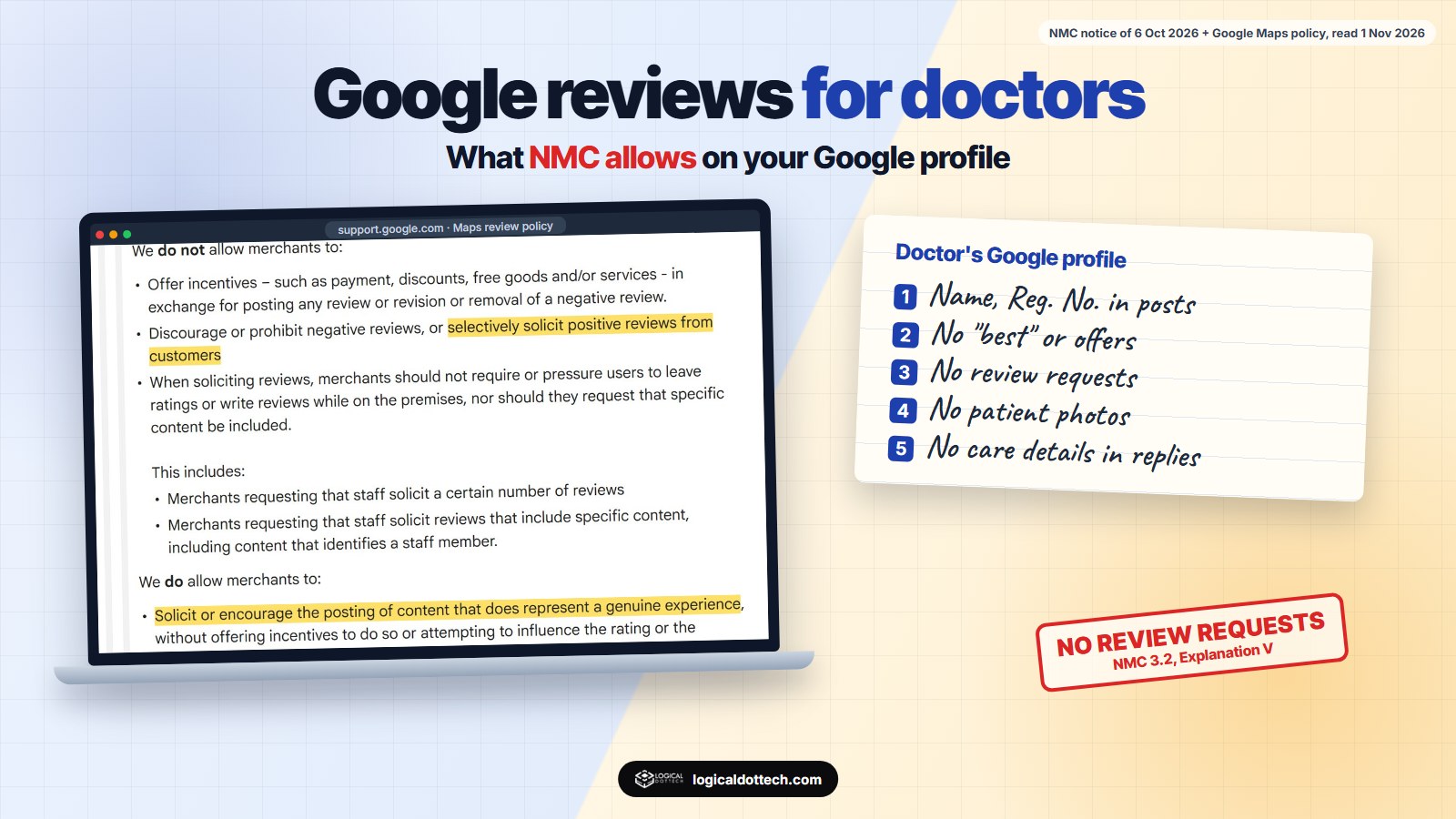
Short answer: a doctor in India can have a Google Business Profile, but since 6 October 2026 NMC’s advertising guidelines decide what goes on it. Keep the profile factual: name, address, timings, services, fees, and your qualifications with your medical register number. Do not use “best” or “No.1”, discount offers, before-and-after photos or patient photos. On reviews, Google lets businesses ask customers for them, but NMC says a doctor shall not request or share patient reviews for professional promotion on social media. So a doctor should not run review requests, and must reply to reviews without saying anything about the person’s care.
We wrote about what NMC allows on a clinic website in October. Since then the most common question from doctors has been about Google: “Can I ask my patients for reviews?” and “What can I post?” We read the NMC notice again together with Google’s own rules on 1 November 2026. This article covers the Google profile only. It is a plain-language reading, not legal advice.
Do NMC rules apply to a Google Business Profile?
Yes, for anything promotional. Clause 3.2 of the NMC guidelines defines advertisement as any communication that directly or indirectly promotes a doctor’s or hospital’s services, skills or facilities. It then adds that “search-engine” and “platform-based” communications are treated as advertising “where their content or manner of dissemination has a promotional character”. Clause 3.5 lists websites, online healthcare platforms and digital marketing campaigns as media of advertisement.
Factual information is a different matter. Explanation II to clause 3.2 allows information about equipment, diagnostic facilities and services “as factual information”, and clause 8.3 lets hospitals share their name, location, contact details, departments, facilities, services, emergency services, accreditation and charges. A Google profile with correct timings, address, services and fees is that kind of information.
Can a doctor ask patients for Google reviews?

This is where NMC and Google pull in different directions.
What NMC says. Explanation V to clause 3.2 has two sentences. The first bars every doctor and hospital from soliciting, buying or publishing fake, paid or misleading reviews. The second goes further: “An RMP shall not request or share patient testimonials, recommendations, endorsements or reviews for professional promotion on social media.” Clause 3.6 defines social media as publications and sharing through internet-based websites and apps that let users create and share content. Google reviews are not named anywhere in the notice, but a public review site where patients post their own content fits that wording.
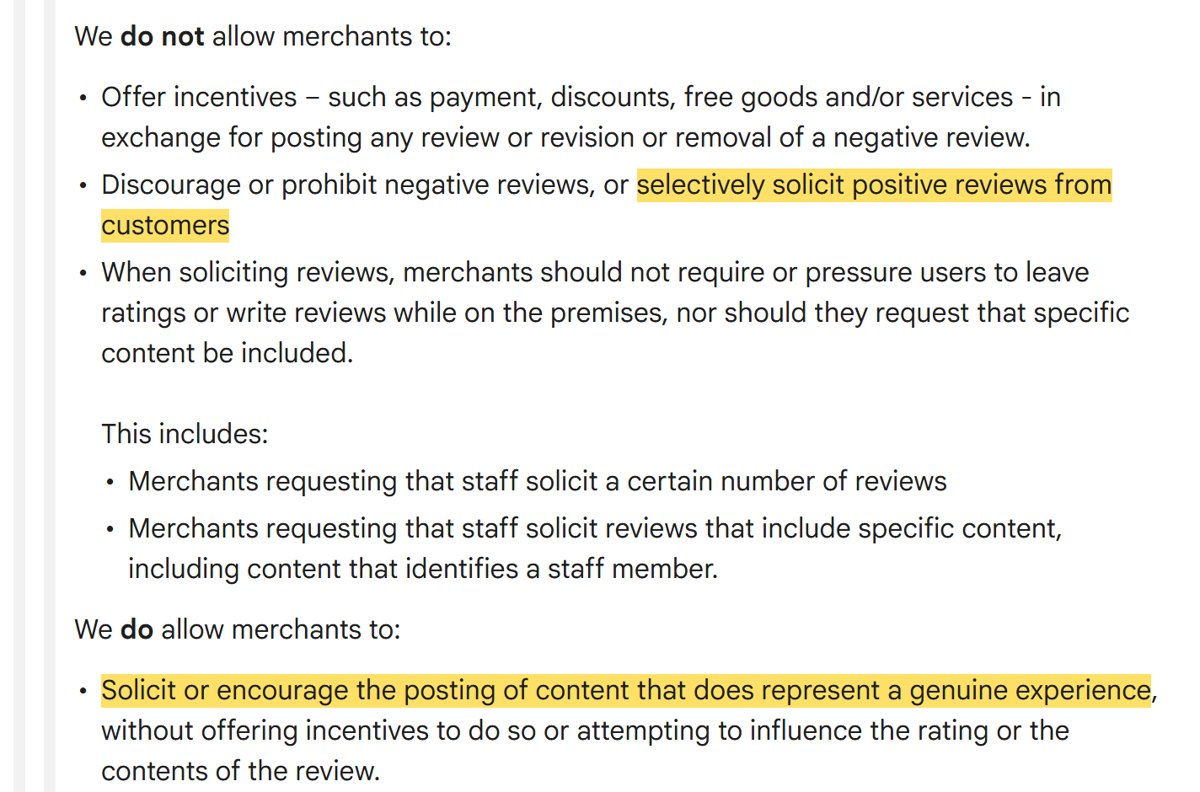
What Google says. Google’s Maps policy allows businesses to “solicit or encourage the posting of content that does represent a genuine experience”, without incentives. It does not allow businesses to “selectively solicit positive reviews”, offer discounts or free services for reviews, pressure people on the premises, or give staff review targets.
Our reading. When two rules apply, the stricter one is the one to follow. For a doctor, that means no review drive: no QR code poster at reception, no WhatsApp message after each visit asking for five stars, no staff asking patients at the counter. Reviews that patients write on their own are fine, and you can make the profile easy to find. Do not copy reviews onto your website, social media or a banner either; “share” is in the same sentence. If you want to ask patients for feedback for a specific reason, ask your State Medical Council in writing first.
Hospitals should be careful too. The second sentence names RMPs, but clause 8.1(xi) says no doctor or hospital may use a third party to do indirectly what they cannot do directly. A hospital asking patients to review a named doctor runs into that.
Google vs NMC: what each allows
| Action | Google’s rules | NMC guidelines (doctors) |
|---|---|---|
| Asking patients for genuine reviews | Allowed, without incentives | Do not request reviews for promotion (3.2 Expl. V) |
| Asking only happy patients | Not allowed | Not allowed |
| Discount, free check-up or gift for a review | Not allowed | Not allowed (8.1(x), 3.2 Expl. V) |
| Fake, paid or employee reviews | Removed | Not allowed (8.1(xii)) |
| Sharing reviews on your website or social media | No rule | Do not share for promotion (3.2 Expl. V) |
| Replying to reviews | Allowed; never share private information | Allowed; patient confidentiality still applies |
| “Best”, “No.1”, “top” in the name or text | Name must match the real name | Not allowed unless verifiable (8.1(ix)) |
One profile for the clinic or one for each doctor?
Google’s guidelines for representing your business name doctors and dentists as “individual practitioners”. The rules are:
- Several doctors at one clinic: the clinic gets its own profile, and each public-facing doctor can have a separate profile. The doctor’s profile title should include only the doctor’s name, not the clinic’s.
- One doctor at a branded clinic: one shared profile, named in the format “Clinic name: Doctor name”.
- A title like “Dr.” or a degree is allowed in a practitioner’s profile.
- One profile per doctor, not one per speciality. A cardiologist who also does general medicine still gets one profile.
- Support staff do not get profiles, and the doctor must be reachable at the verified location during the stated hours.
If your clinic runs from a home or does home visits, our article on a Google Business Profile without a shop address explains what Google allows.
What to put on a doctor’s Google profile
- Your real name and the clinic’s real name, exactly as on the signboard. No “best” or keywords added.
- Qualifications and register number in the description. Explanations III and IV to clause 3.2 say electronic media posts should show the doctor’s name, qualifications, registration status and State or National Medical Register number. Put them in the description and at the end of every post.
- The most specific category, such as “Dentist” or “Pediatrician”, then only the extra categories that match real services.
- Services described plainly. What it is and who it is for. No promised outcome, no “painless”, no success rates (8.1(iii)).
- Fees, if you list them, stated factually. The notice says any disclosure of charges must be “factual, transparent and not misleading”. Skip Google’s “Offer” posts with discounts; clause 8.1(x) bars discounts and limited-period offers that encourage unnecessary consultations.
- Photos of the premises, equipment, signboard and team. No patients, no before-and-after photos (8.1(v)), and no AI-made images of patients or doctors.
- Timings, phone and holiday hours kept correct. This is the information patients use most, and it is plainly factual.
What can a doctor post on Google?
Clause 8.2(ii) lists formal announcements a doctor may make: starting practice, a change of type of practice, a change of address, temporary absence from duty, resumption of another practice, succeeding to another practice, and a public declaration of charges. Clause 8.2(v) allows greetings on national days, as long as they carry no advertisement. Health information written to inform, such as monsoon dengue precautions, also fits.
Clause 8.3(ii) adds a warning: “The form, medium or frequency of communication shall not convert otherwise factual information into solicitation.” A weekly factual post is fine. Posting every day to push consultations could tip into solicitation, even if each post on its own is factual.
How to reply to reviews without breaking confidentiality
Google says the reviewer is notified of your reply, the reply shows publicly under the review as a business reply, and you can edit or delete it later (Google Business Profile Help). Google’s review tips say to keep replies short and polite and to “never share a reviewer’s private information”. For a doctor there is one more rule: do not confirm that the reviewer was your patient, and say nothing about a diagnosis, treatment or visit.
Do not write
“Glad your root canal went well, Mr Sharma. See you for the crown next month.” It confirms he is a patient and names a treatment.
“You came without an appointment and refused the X-ray.” It discloses a visit and a clinical decision.
Write instead
“Thank you for taking the time to write. For anything about your care, please call the clinic on [number] and ask for the clinic manager.”
“We are sorry to read this. We cannot discuss anyone’s care here, but we would like to hear more. Please call us on [number].”
Reply to good and bad reviews in the same calm way. If a review is fake, comes from a competitor or a former employee, or posts someone’s medical details, report it from your profile; Google’s policy bars conflict-of-interest reviews and posting personal information, including medical information, without consent. A genuine negative review will stay, and a calm reply is what other patients will read.
Where an agency fits, and where it does not
We are a digital agency, so we read clause 8.1 with our own work in mind. Clause 8.1(ii) says doctors shall not “engage any third party for marketing medical services”, and clause 8.1(viii) says payments to agencies must not be linked to the referral of individual patients. Clause 4.4 adds that using an agency does not move responsibility away from the doctor.
What we do for clinics is technical and factual: set up and verify the Google profile correctly, keep timings, services and photos accurate, build a factual clinic website that loads fast and shows registration details, and fix errors. We charge a flat fee, never per patient or per lead, and we do not run review campaigns or promotional ads for doctors. For other kinds of businesses, our Google Business Profile optimisation service covers reviews and posts as well.
A 10-minute check of your profile
- Does the name match your signboard exactly?
- Do the description and posts show your qualifications and register number?
- Any “best”, “No.1”, “painless” or “guaranteed” anywhere? Remove it.
- Any discount or free check-up offer? Remove it.
- Any photo showing a patient or a before-and-after result? Remove it.
- Any QR poster or message asking for reviews? Take it down.
- Do any of your replies confirm a visit or mention a treatment? Edit them.
- Are timings, holiday hours and phone number correct?
If you would like us to go through your profile with you, book a free 30-minute call.
Common questions
Can a doctor ask patients for Google reviews in India?
NMC’s guidelines of 6 October 2026 say an RMP shall not request or share patient reviews for professional promotion on social media, and they define social media broadly. Google reviews are not named, but the safer course for a doctor is not to run review requests: no QR posters, no WhatsApp messages asking for stars. Google itself allows asking for genuine reviews, so this is a case where the NMC rule is stricter than Google.
Can a clinic reply to Google reviews?
Yes. Google allows owners to reply and notifies the reviewer. A doctor should keep the reply short and general, and never confirm that the person was a patient or mention a diagnosis, treatment or visit detail. Move anything specific to a phone call.
Should each doctor in a clinic have a separate Google profile?
Google’s guidelines allow a separate profile for each public-facing practitioner who can be contacted at the location during stated hours, alongside a profile for the clinic. If you are the only doctor at a branded clinic, Google recommends one shared profile named “Clinic name: Doctor name”.
Can I write “best dentist” or “No.1 clinic” in my Google profile?
No. Clause 8.1(ix) bars words like “best”, “No.1”, “leading” and “top” unless the claim is objectively verifiable with a transparent method. Google’s own guidelines also say the business name must match your real-world name, so a keyword like “best” in the name can get the profile suspended.
What can a doctor post on Google Business Profile?
Factual updates: new timings, a change of address, leave and return dates, a new department or equipment, fees, and general health information. Clause 8.2 allows formal announcements such as starting practice, changing address or temporary absence. Every post should show the doctor’s name, qualifications and State or National Medical Register number.
Can I remove a bad Google review of my clinic?
Only if it breaks Google’s content policy, for example if it is fake, from a competitor or an employee, or posts someone’s personal medical information. Report it from your profile. A negative but genuine review stays; a calm, general reply is the best answer.
Sources read on 1 November 2026: National Medical Commission, Public Notice No. R-13014/01/2024-Ethics dated 06/10/2026, Guidelines on Ethical Advertising and Public Communication (clauses 3.2, 3.5, 3.6, 4.4, 8.1, 8.2, 8.3); Google, Guidelines for representing your business on Google; Google Maps user-generated content policy; Google Business Profile Help, Read and reply to reviews; Google Business Profile Help, Tips to get more reviews. This article is general information, not legal advice. NMC may issue clarifications, so check nmc.org.in and your State Medical Council for updates.