
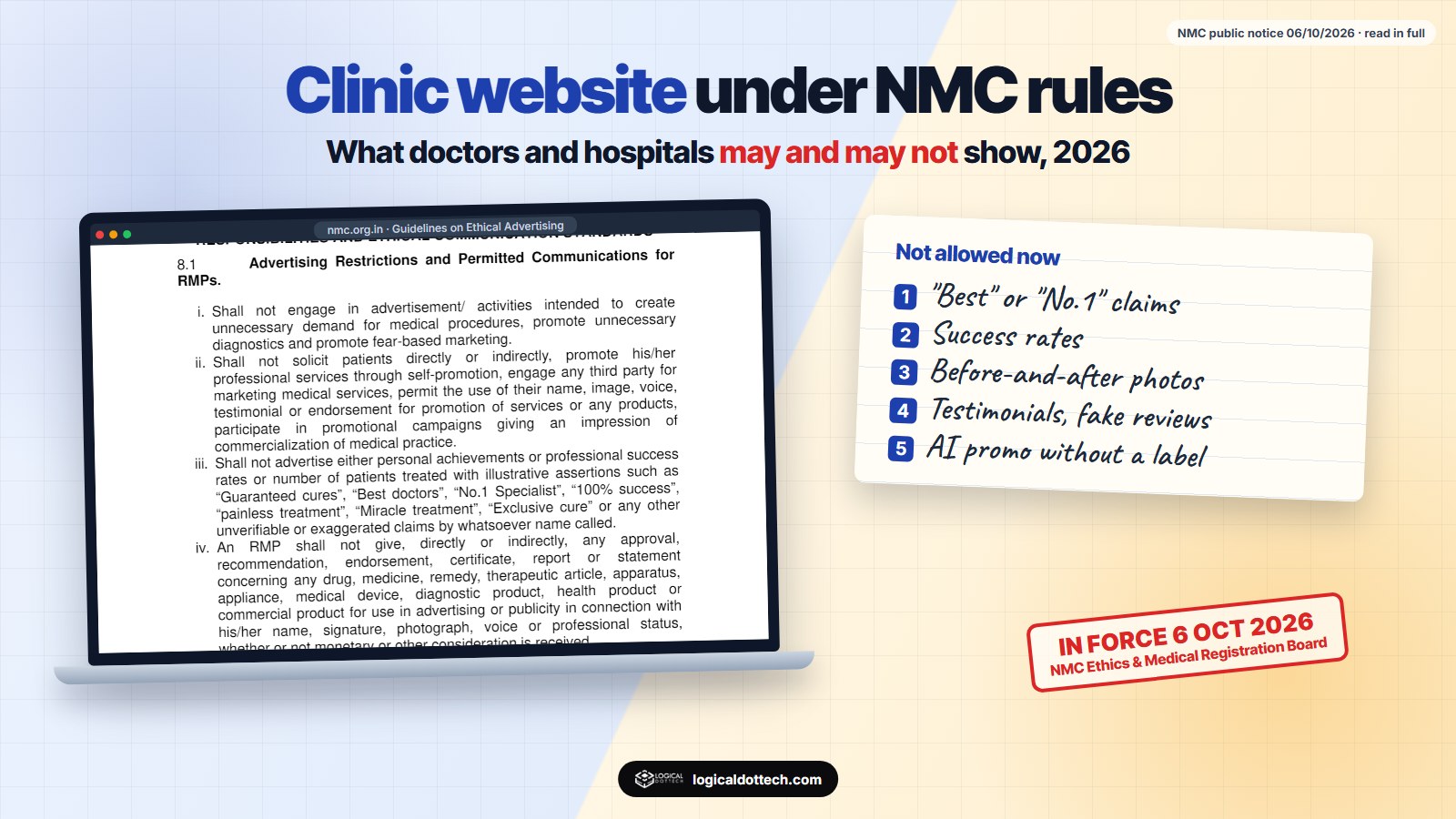
Short answer: since 6 October 2026, NMC’s guidelines on ethical advertising apply to every website, blog, social media page and WhatsApp message from doctors and hospitals in India. A clinic website may show factual, verifiable information: name, address, contact, departments, facilities, services, emergency services, accreditation, fees, and its doctors with qualifications and registration numbers. It must not use “best” or “No.1” claims, success rates, testimonials, before-and-after photos, inducements like free check-up coupons, fake reviews, or AI-made promotional content.
We build websites for clinics and hospitals, so we read the full NMC notice, all 13 pages, before writing this. Below is what it means for a clinic website, page by page. This is a plain-language summary, not legal advice; for your own case, read the notice and ask your State Medical Council.
What did NMC issue in October 2026?
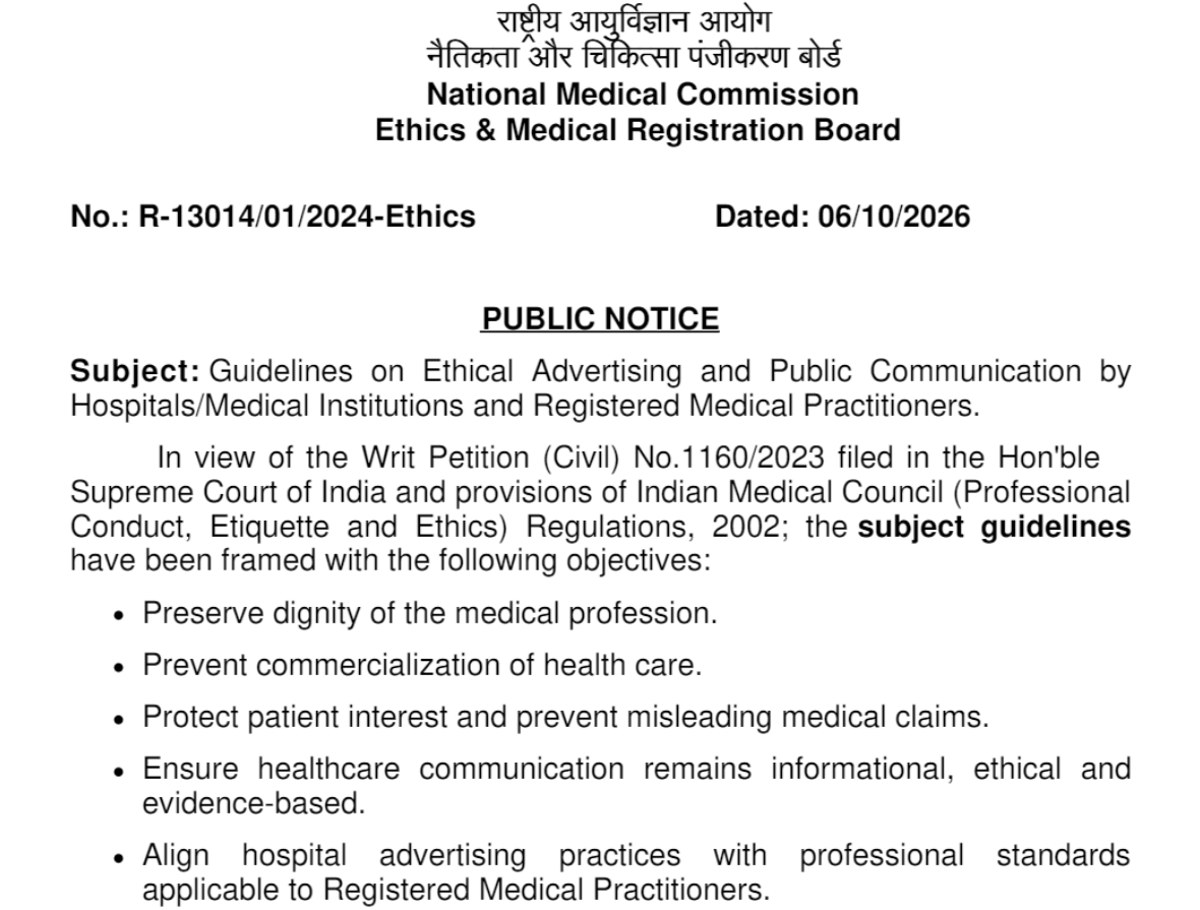
The Ethics and Medical Registration Board of the National Medical Commission issued “Guidelines on Ethical Advertising and Public Communication by Hospitals/Medical Institutions and Registered Medical Practitioners” on 6 October 2026, in force with immediate effect. They were framed in view of a Supreme Court writ petition and the 2002 professional conduct regulations, and are read together with them.
Three points matter most for websites:
- Websites count. Clause 3.5 lists websites and blogs, social media, WhatsApp and other messaging apps, podcasts, influencer marketing, sponsored posts and AI-generated promotion as media of advertisement.
- Agencies do not shield you. Clause 4.4 says using a digital platform, agency or influencer does not free the doctor or hospital from responsibility for content they authorised or allowed.
- Hospitals are covered too. Hospitals and clinics follow the guidelines alongside the Clinical Establishments Act or the state law that applies to them.
What a clinic website may show
| Allowed, when factual and verifiable | Where the notice says so |
|---|---|
| Name, location, contact details | 8.3(i), 9.1 |
| Departments, facilities, equipment, services, emergency services | 8.3(i), 9.1 |
| Accreditation status | 8.3(i), 9.1 |
| Charges, packages or fees, stated factually | 8.1(x), 8.3(i), 9.1 |
| A directory of doctors with names, recognised qualifications, specialties, registration details and availability | 9.1, treated as patient information |
| Formal announcements: starting practice, change of address or type of practice, temporary absence, consultation fees | 8.2(ii), 9.3 |
| Health education that does not promote the practice | 5.1, 8.2(iv) |
Explanation III and IV to clause 3.2 add a rule for online posts: a doctor posting should state their name, qualifications, registration status and SMR or NMR registration number, and a clinic posting should name its doctors with the same details.
What a clinic website must not show
| Not allowed | Clause |
|---|---|
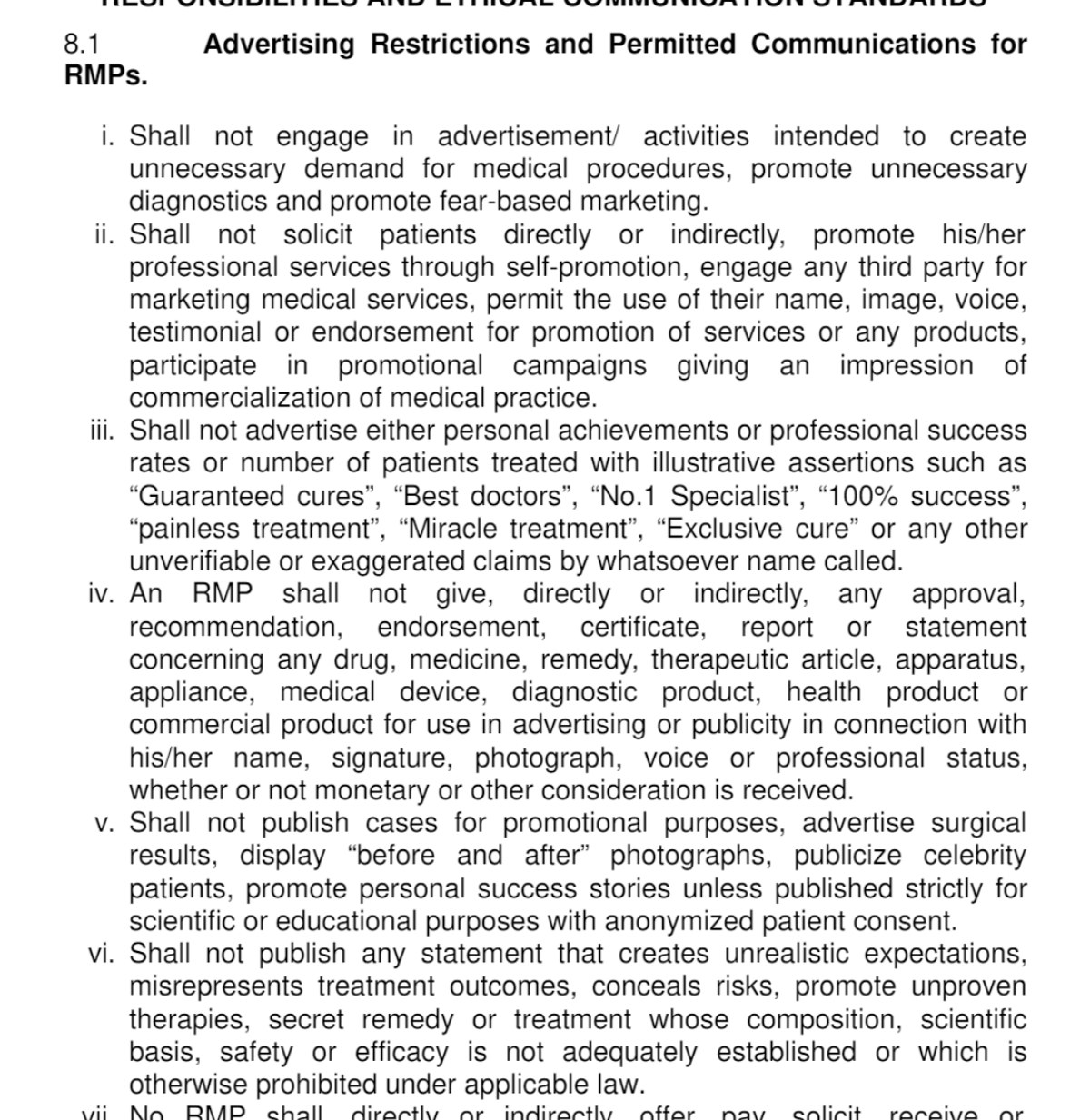
| “Guaranteed cures”, “Best doctors”, “No.1 Specialist”, “100% success”, “painless treatment”, “miracle treatment” | 8.1(iii) |
| “Best”, “leading”, “most trusted”, “top” and similar, unless objectively verifiable with a disclosed method | 8.1(ix) |
| Success rates or the number of patients treated | 8.1(iii) |
| Before-and-after photos, surgical results, celebrity patients, promotional success stories | 8.1(v) |
| Testimonials, endorsements, and asking for or sharing patient reviews for promotion on social media | 3.2 Expl. V, 8.1(ii), 8.1(xi) |
| Fake or paid reviews, followers or likes, or manipulating search rankings | 3.2 Expl. V, 8.1(xii) |
| Discounts, coupons, free procedures, cashbacks or referral benefits that push unnecessary care | 8.1(x) |
| Fear-based marketing, or content that creates demand for unnecessary tests or procedures | 8.1(i) |
| Patient names, faces or other identifying details | 6, 7.4 |
| A doctor’s photo used as self-advertisement | 9.2 |
| Payment to an agency or platform linked to each patient referred | 8.1(vii), 8.1(viii) |
What about AI-written content?
Clause 7.2 is strict. AI-generated promotional campaigns for commercial interest are prohibited. Any AI-generated promotional content that is otherwise allowed must carry a source mark saying it was made by AI. AI must not be used to create misleading claims, or a patient’s image, voice, testimonial or outcome, or a synthetic endorsement. Patient information fed into an AI tool must follow privacy and data-protection law.
In practice: write clinic pages and health articles yourself or with a writer, have the doctor check them, and do not use AI-generated images of patients or doctors.
A compliant clinic website, page by page
- Home: clinic name, specialties, address with map, timings, phone, and a clear way to book an appointment. No “best” or “No.1”.
- Doctors: each doctor’s name, recognised qualifications, specialty, registration number and consultation days. Factual, no promotional language.
- Services and facilities: what each service is, who it is for and what equipment you have. Describe risks honestly; promise no outcome.
- Fees: consultation fees and packages stated plainly, with what is included.
- Health information: educational articles reviewed by a doctor, written to inform, not to pull patients in.
- Contact and appointments: address, map, phone, WhatsApp, timings and emergency information.
- Privacy: a privacy notice that explains how you handle personal data from forms and bookings, in line with the Digital Personal Data Protection Act, 2023 and its 2025 Rules, which clause 7.6 names.
How does this fit with SEO?
Well, as it happens. Google’s guidance on helpful content says that for topics that can affect health, its systems give more weight to content showing strong experience, expertise, authoritativeness and trust, and it asks whether content is “written or reviewed by an expert”. Accurate, factual, doctor-reviewed pages are what both NMC and Google want. What you give up is the hype, which neither rewards.
Your Google Business Profile follows the same rules. Keep it factual, never post or buy fake reviews, and take care when replying to reviews: do not confirm that someone was your patient or mention any treatment details.
Common questions
Can a doctor in India have a website?
Yes. NMC’s October 2026 guidelines allow factual, verifiable information. A hospital website with a directory of its doctors, their recognised qualifications, specialties, registration details and availability is treated as patient information, not promotion. What is not allowed is self-promotion, superlatives, testimonials and before-and-after photos.
Can I write “best doctor” or “No.1 clinic” on my website?
No. The guidelines list “Best doctors”, “No.1 Specialist”, “100% success”, “Guaranteed cures” and “painless treatment” as examples of claims RMPs must not make, and bar words like “best”, “leading” and “top” unless the claim is objectively verifiable.
Can a clinic show patient reviews or testimonials on its website?
Not for promotion. The guidelines say RMPs must not permit their name, image or a testimonial to be used to promote services, and must not request or share patient testimonials or reviews for professional promotion on social media. Fake or paid reviews are banned outright.
Can I post before-and-after photos of treatment?
No, not for promotion. Clause 8.1(v) says RMPs shall not display “before and after” photographs or advertise surgical results, except strictly for scientific or educational purposes with anonymised patient consent.
Can I use AI to write my clinic’s content?
Not for promotional campaigns. Clause 7.2 prohibits AI-generated promotional campaigns for commercial interest, and any permitted AI-generated promotional content must carry a mark stating that it was made by AI. AI must never create patient images, testimonials or endorsements.
What must a doctor show when posting online?
Explanation III to clause 3.2 says an RMP publishing electronic media posts should disclose their name, qualifications, registration status and State or National Medical Register number. Clinics posting online should disclose the names of their RMPs with the same details.
Do these rules apply to dentists and AYUSH doctors?
The notice is issued by NMC for Registered Medical Practitioners under the NMC Act, and hospitals under the Clinical Establishments Act or state law. Dentists and AYUSH practitioners have their own councils, so check their rules too. The notice says one aim is ethical parity across all systems of medicine.
If you run a clinic or hospital and want a website built within these rules, see our website design and development service or, if you are near us, website designing in Fatehabad. Book a free 30-minute call and we will review your current site against the notice with you.
Source: National Medical Commission, Ethics and Medical Registration Board, Public Notice No. R-13014/01/2024-Ethics dated 06/10/2026, Guidelines on Ethical Advertising and Public Communication, read in full on 20 October 2026; and Google Search Central, creating helpful, reliable, people-first content. Clause numbers refer to the annexed guidelines. This article is general information, not legal advice. NMC may issue clarifications under clause 12, so check nmc.org.in for updates.