
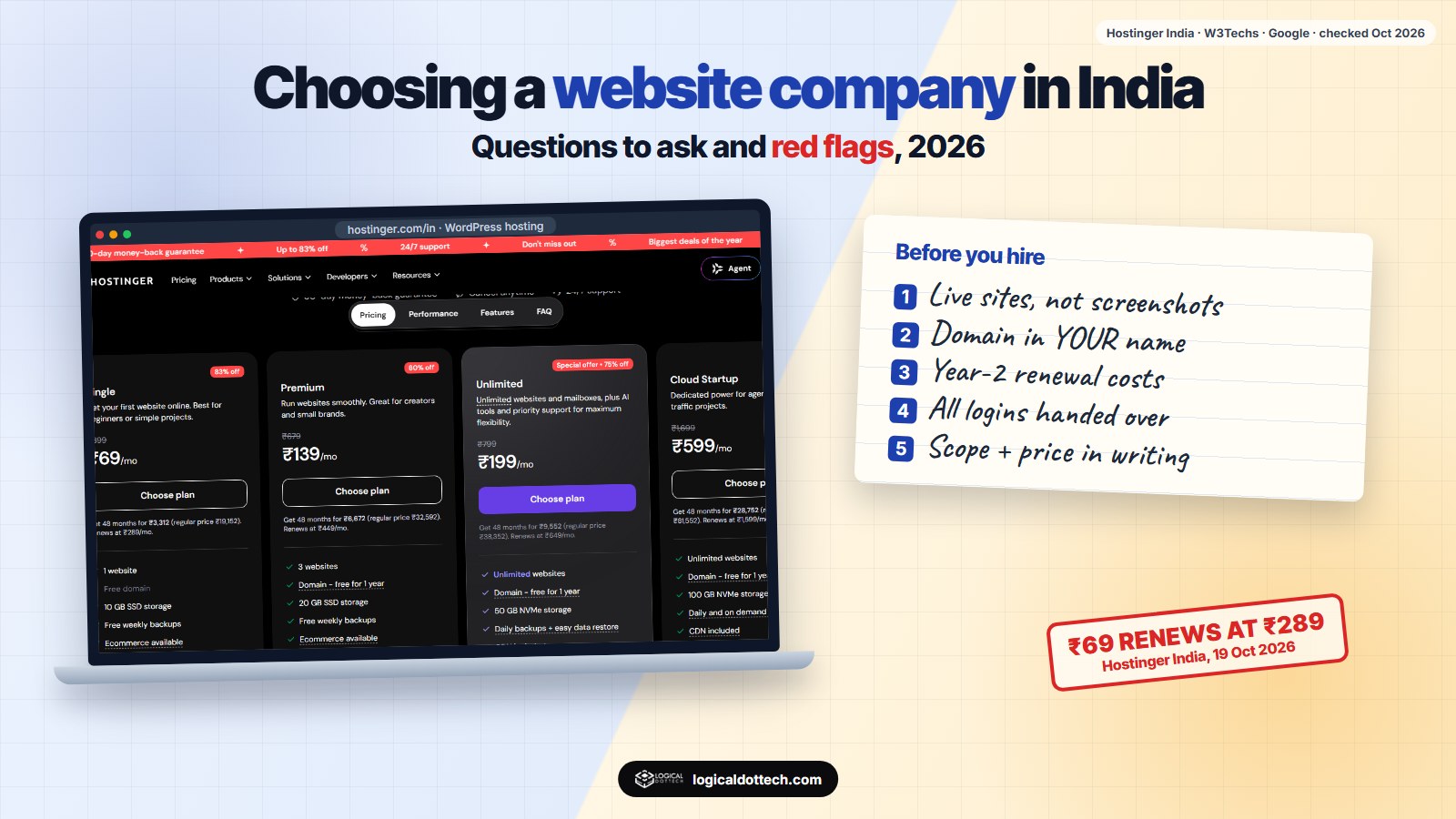
Short answer: choose a website company that shows live sites it built, puts the scope and price in writing, registers the domain and hosting in your name, hands over every login, and tells you the renewal costs for year two along with the offer price. Be careful with anyone who promises first place on Google, keeps the domain in their own name, or asks for full payment upfront.
We are a web development company ourselves, based in Fatehabad, Haryana, so read this knowing that. The checklist below is the one we would want a client to use on us. It includes live hosting prices and guidance from Google and ICANN, checked on 19 October 2026.
Questions to ask before you hire
| Ask | A good answer | A red flag |
|---|---|---|
| Can I see live sites you built? | Links you can open, with clients you can call | Only screenshots or templates |
| Whose name is the domain in? | Yours, with your email and your login | “We keep it in our account for you” |
| What will hosting cost in year two? | The exact renewal price, in writing | Only the first-year offer price |
| Will I get the admin login and all files? | Yes, at hand-over | “We will make changes for you whenever you need” |
| Which platform, and why? | A common one, with a reason that fits your business | A custom system only they can edit |
| Are the themes and plugins licensed? | Yes, from the official source | Free copies of paid themes |
| How do payments work? | Split by milestone | 100% upfront |
| Can you get us to #1 on Google? | “No one can promise that. Here is what we will do” | “Yes, guaranteed” |
Who should own the domain, hosting and logins?
You should. The domain is your address on the internet, and ICANN’s registrant responsibilities put the duty to keep the registration details and registrar account current on the registrant. If that is the developer, you depend on them every time you want to renew, move or change anything.
- Domain: registered with your name and an email you control.
- Hosting: an account in your name, or a written note of who pays and how you can move it.
- Website admin: an administrator login for you, separate from the developer’s.
- Files: the design files and a full backup handed over at the end.
- Accounts: Google Business Profile, Search Console and Analytics added with your Google account as owner.
What does hosting really cost after the first year?
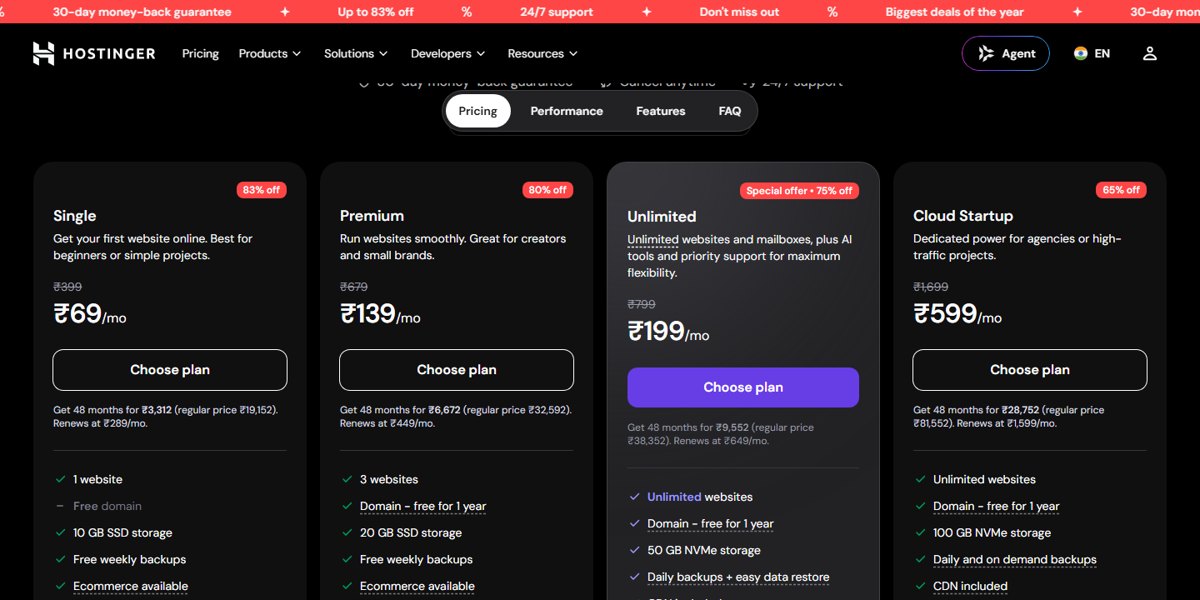
This catches many small businesses. Here is what Hostinger India showed for WordPress hosting on 19 October 2026:
| Plan | Offer price | Paid upfront for 48 months | Renews at |
|---|---|---|---|
| Single | ₹69/mo | ₹3,312 | ₹289/mo |
| Premium | ₹139/mo | ₹6,672 | ₹449/mo |
| Unlimited | ₹199/mo | ₹9,552 | ₹649/mo |
| Cloud Startup | ₹599/mo | ₹28,752 | ₹1,599/mo |
Nothing wrong with that, as long as you know it. The low price needs a long term paid upfront, and on the plans that include a free domain, it is free for the first year only. Ask your developer to write down the yearly cost of hosting, domain, paid plugins and maintenance for year one and year two.
Which platform should your website use?
Pick a platform many developers know, so you are never stuck with one company. W3Techs reported on 19 October 2026 that WordPress runs 39.6% of all websites and 58.4% of sites whose content system it can detect. For most business websites that makes it a safe choice. For an online store, compare it with Shopify first; we explain the difference in WordPress vs Shopify.
A fully custom system can make sense for a web app with special features. For a business website it often means only the company that built it can change it.
Red flags to walk away from
| Red flag | Why it matters |
|---|---|
| Guaranteed first place on Google | Google says “No one can guarantee a #1 ranking on Google” |
| Domain registered in the developer’s name | You need their help to renew, move or change it |
| Paid themes or plugins at no cost | Unofficial copies get no security updates and can carry malware |
| No written scope | Every extra page or change becomes an argument |
| Full payment before any work | You have nothing left to hold back if the work stops |
| No admin login for you | You cannot fix a typo or leave without them |
| No mobile check in the demo | Most of your visitors will open the site on a phone |
What should the contract or quote include?
- Scope: the list of pages and features, and who writes the text and supplies the photos.
- Timeline: dates for the design, the first working version and launch.
- Changes: how many rounds of changes are included, and the rate after that.
- Payments: split by milestone, for example at start, at design sign-off and at launch.
- Ownership: that the design, content and code are yours once paid.
- Hand-over: all logins, files and a backup.
- Maintenance: what the yearly maintenance (AMC) covers, such as updates, backups and small edits, and what it costs.
- Invoice: a proper GST invoice if the company is GST-registered.
Questions about SEO, if they offer it too
Many web companies also sell SEO. Google’s own page on hiring an SEO suggests asking for examples of past work, whether they follow Google Search Essentials, what results they expect and in what time, their experience in your industry and your city, and whether they will explain every change they make. Those are good questions for any agency, including us.
If you would like a quote that answers every question on this page in writing, see our web design and development service or, if you are near us, website designing in Fatehabad. Book a free 30-minute call and we will go through your project with you.
Common questions
Who should own the domain name, me or the developer?
You. Register the domain in your own name and email, or ask the developer to do it that way, and keep the login. If the developer’s name is on it, moving the site later can turn into a fight.
What should a website development contract in India include?
The pages and features in writing, who supplies the text and photos, the timeline, how many rounds of changes, the payment split by milestone, who owns the design and code, the hand-over of all logins, what the yearly maintenance covers and costs, and a GST invoice if the company is registered.
Why is my hosting renewal so much higher than the first year?
Hosting companies sell the first term at a discount. On 19 October 2026, Hostinger India showed its Single WordPress plan at ₹69 a month for a 48-month term, renewing at ₹289 a month. Ask your developer for the renewal price as well as the offer price.
Is WordPress a good choice for a business website?
For most business websites, yes. W3Techs reported on 19 October 2026 that WordPress runs 39.6% of all websites, so it is easy to find another developer later. For an online store, compare it with Shopify before you decide.
Can a website company guarantee first place on Google?
No. Google’s own guide to hiring an SEO says no one can guarantee a #1 ranking on Google. Treat that promise as a red flag.
How do I check a web company’s past work?
Ask for live links, not screenshots, and open them on your phone. Check that the sites load fast, the contact forms work, and the footer or the client confirms who built them. Call one or two past clients if you can.
Sources checked on 19 October 2026: Hostinger India WordPress hosting prices, W3Techs, usage statistics of WordPress, ICANN, Registrants’ Benefits and Responsibilities and Google Search Central, Do you need an SEO?. Hosting prices change often; check the live page before you buy.