
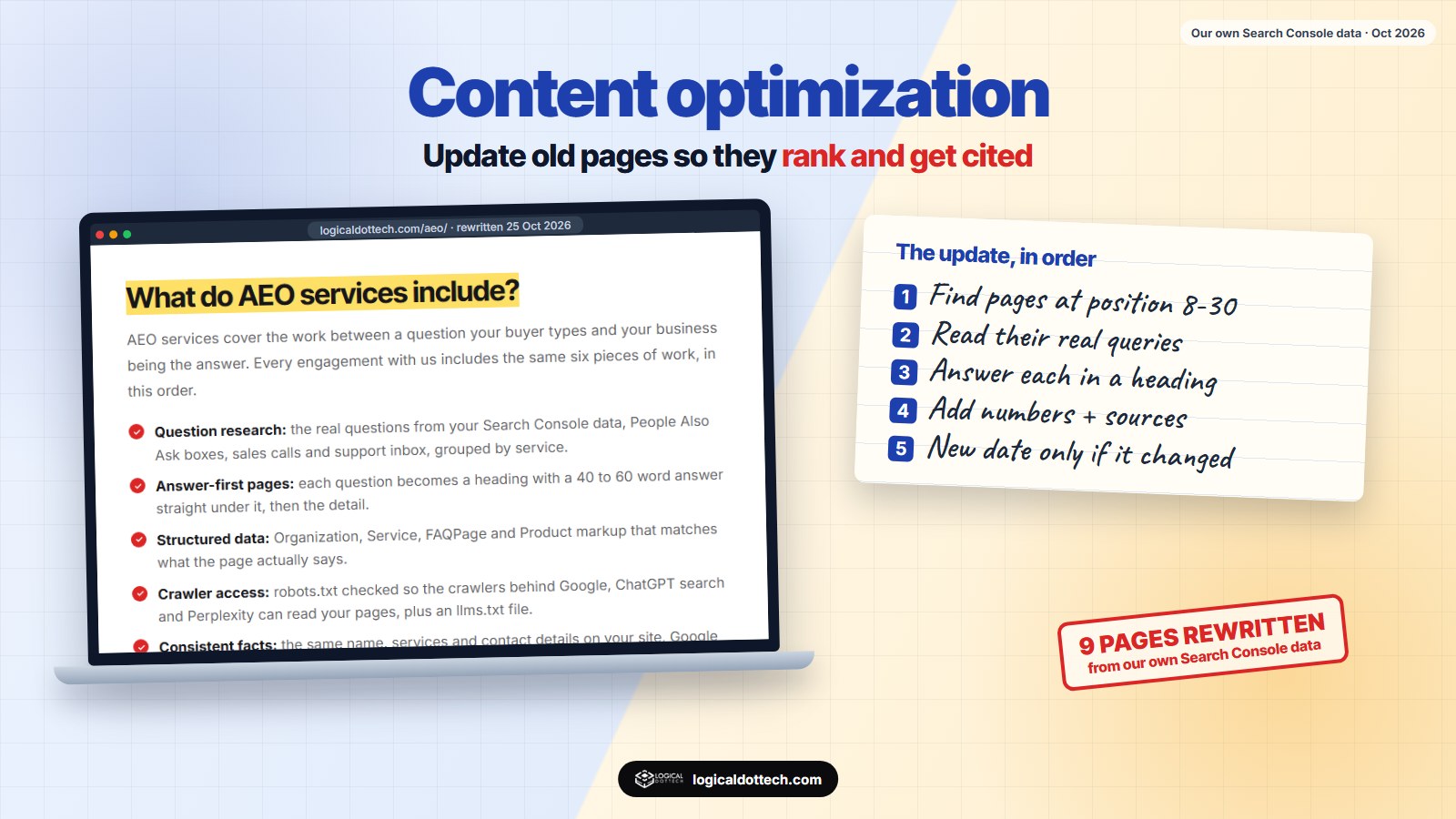
Short answer: content optimization means improving pages you already have instead of writing new ones. Open Search Console, find pages shown for searches they do not answer, usually at positions 8 to 30, and rewrite them around those exact searches: the question as a heading, a short direct answer, evidence such as numbers and sources, a better title and internal links. Change the visible date only when the page really changed, then judge the result after four to eight weeks.
We did exactly this to nine of our own service pages on 25 October 2026, so this guide uses our real pages, our real Search Console numbers and the exact changes we made. Our view: for most small business sites, the next ranking gain is hidden in pages that already exist. Google is already showing them; they just do not answer what people typed.
What is content optimization?
Content optimization is the work of improving an existing page so it matches what people search, ranks higher and gets quoted by AI tools. It is different from writing new content: the page already has a URL, links and some trust with Google, so a good update often moves faster than a new article. Typical changes are new sections that answer missing questions, a clearer title, evidence, internal links, and removing outdated or thin parts.
How to find pages worth optimizing
- Open the Performance report in Google Search Console for the last three months.
- Go to the Pages tab and sort by impressions. Note pages with an average position between about 8 and 30: Google already considers them relevant but not good enough for the top.
- Click one page, then the Queries tab. This shows the exact searches it appears for.
- Read the page against that list. For each query, ask: does the page answer this in a heading and the first lines under it?
- Pick the gaps. Queries with impressions that the page never answers are your to-do list.
Skip pages already in the top three unless something is broken. The risk of losing what works is higher than the gain.
Our own example: nine pages on 25 October 2026
This is what Search Console showed for some of our service pages (90 days to 22 October 2026), what we changed, and the visible word count before and after:
| Page | What Search Console showed | What we changed | Words before and after |
|---|---|---|---|
| /aeo/ | “aeo services”: 73 impressions, position 29; the phrase was not on the page | New title and H1 around “AEO services”, four new sections, AEO vs SEO table | 1,584 to 2,290 |
| /web-development/ | About position 11 for website development searches, four FAQs, no list of real projects | Table of eight real client sites, cost factors, stack, four more FAQs | 1,139 to 1,766 |
| /custom-ai/ | “custom llm development”: 10 impressions, position 23 | Retitled “Custom LLM Development Services”, RAG vs fine-tuning vs private model table | 1,950 to 2,577 |
| /meta-ads/ | “meta ads”: 211 impressions at position 44, a search the page could not win | Re-aimed at “Meta ads management services”, Instagram ads section, Boost vs managed table | 1,557 to 2,031 |
| /roofing-seo/ | “seo for roofing contractors”: 17 impressions, position 22 | First 90 days, shared leads vs SEO table, how to choose | 1,491 to 2,071 |
| /b2b-seo-agency/ | “b2b seo firm”: 10 impressions, position 10.8 | What is B2B SEO, first 90 days, how to choose, AI search | 1,608 to 2,085 |
The /aeo/ page is the clearest case. It was shown 73 times for “aeo services”, but the page only talked about AEO “in India”, so it had nothing to rank with. We added the section people were looking for:
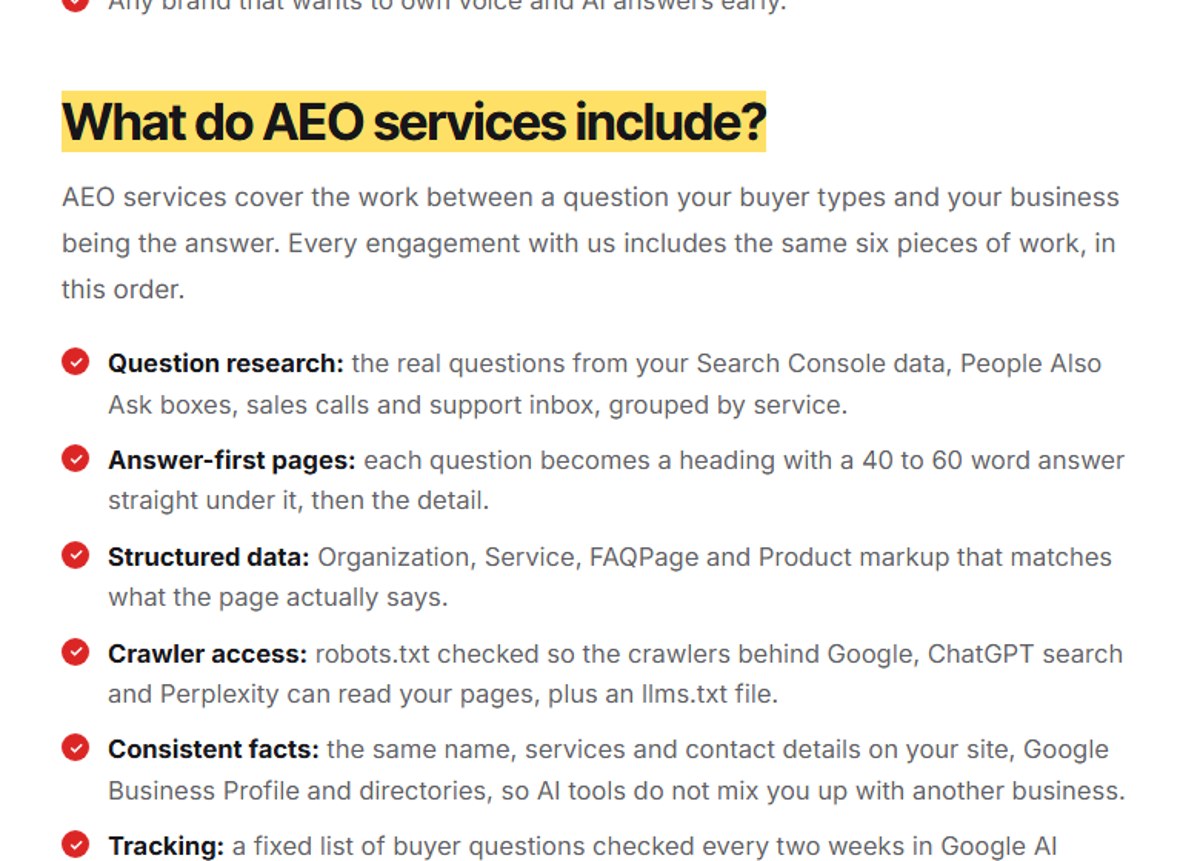
We do not have the results yet: Google needs a few weeks to recrawl and re-rank. We will add the same queries, before and after, to this article. What we can already say: on the six pages in the table the word count went up by 30% to 55%, and every new section answers a query that was already in Search Console. Length was the result, not the goal.
A content optimization checklist
| Check | What to do |
|---|---|
| Search match | Every query with real impressions is answered in a heading and the first lines under it |
| Title and description | Use the words people searched, under about 60 characters for the title |
| Short answer first | A two or three sentence answer at the top, for readers and for AI tools |
| Evidence | Your own numbers, named sources, quotes from real customers |
| Tables | Comparisons and steps in tables or numbered lists |
| Internal links | Link to the page from related pages and articles, and from it to the next step |
| Out-of-date facts | Prices, rules, screenshots and years checked and corrected |
| Date | Update the visible date only when the page changed in a real way |
| Recrawl | Request indexing in Search Console after a big update |
What Google says about updating the date
Changing the date without changing the page is a common shortcut. Google’s guidance on dates is direct about it:
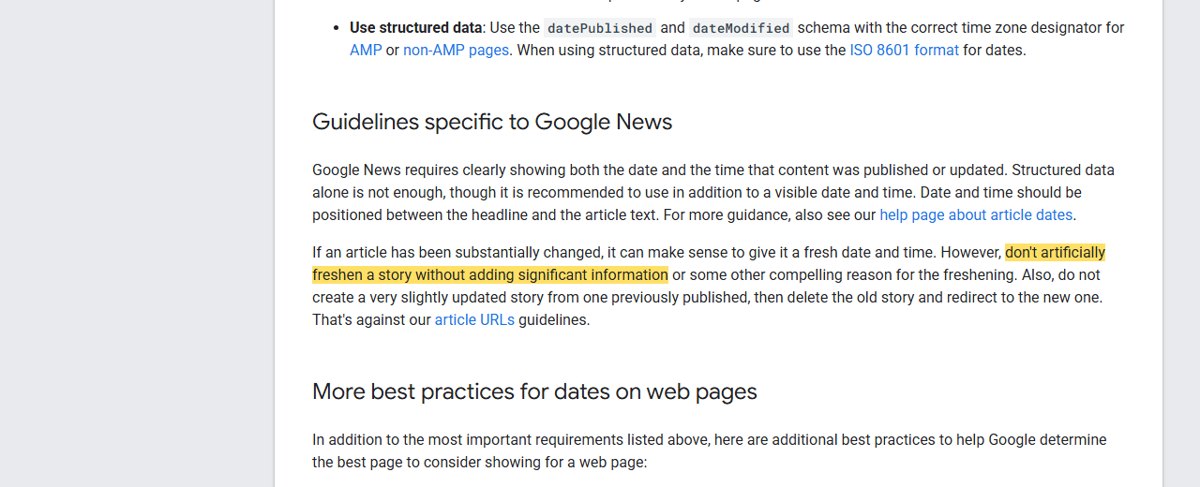
The same post says that if you update a page significantly, you should also update the visible date, and you can show two dates: when it was first published and when it was updated. Google’s byline date documentation adds that its systems look at several factors to estimate when a page was published or significantly updated, so a new date on an unchanged page is unlikely to fool anyone.
How to optimize content for AI answers too
The same update can help with ChatGPT, Gemini and Google AI Overviews. In the GEO study (KDD 2024), adding quotations, statistics and cited sources made pages noticeably more visible in AI-written answers, while stuffing in keywords made them less visible. In practice: put a short answer near the top, add your own numbers, link your sources, and keep facts consistent with your Google Business Profile and listings. Our guide GEO vs AEO vs SEO explains how the three fit together.
What not to do
- Do not stuff keywords. It did not help in the GEO study and reads badly.
- Do not change the URL unless you must; if you do, add a 301 redirect.
- Do not refresh only the date. See Google’s guidance above.
- Do not rewrite a page that already ranks in the top three without a clear reason.
- Do not judge in a week. Compare the same queries after four to eight weeks.
If you want this done on your site, our AI SEO services start with exactly this audit of your own Search Console data, and our AEO services cover the answer-first rewrite. Book a free 30-minute call and we will show you which three pages on your site to update first.
Common questions
What is content optimization?
Content optimization is improving pages you already have so they answer what people search, rank higher and get quoted in AI answers. It usually means adding the questions a page is shown for but does not answer, adding evidence, fixing titles and internal links, and removing what is out of date.
How often should I update old content?
When the data says so, not on a calendar. Check Search Console every month or two for pages with impressions but a position between about 8 and 30, or for pages whose clicks are falling, and update those first.
Does changing the date on a page help rankings?
Not on its own. Google says not to artificially freshen a story without adding significant information. Update the visible date when the page has really changed, and you can show both the original and the updated date.
Can updating a page hurt its rankings?
It can, if you remove what was working or change the URL without a redirect. Leave pages that already rank in the top three alone unless something is wrong, keep the URL, and add to a page rather than rewriting it from scratch.
How long does content optimization take to show results?
Google has to recrawl the page first, which can take days to weeks; requesting indexing in Search Console can speed that up. We judge a change after four to eight weeks, comparing the same queries before and after.
What do content optimization services include?
A good service starts from your own Search Console data, picks the pages closest to page one, rewrites them around the real queries, adds evidence and internal links, and reports the same queries before and after. Be wary of any service that only adds keywords.
Sources checked on 26 October 2026: Google Search Central blog, Help Google Search know the best date for your web page (11 March 2019), Google Search Central, byline dates and Aggarwal et al., GEO: Generative Engine Optimization, KDD 2024. Search Console figures and word counts are our own, for logicaldottech.com; word counts were measured on the live pages before and after the 25 October 2026 update.