
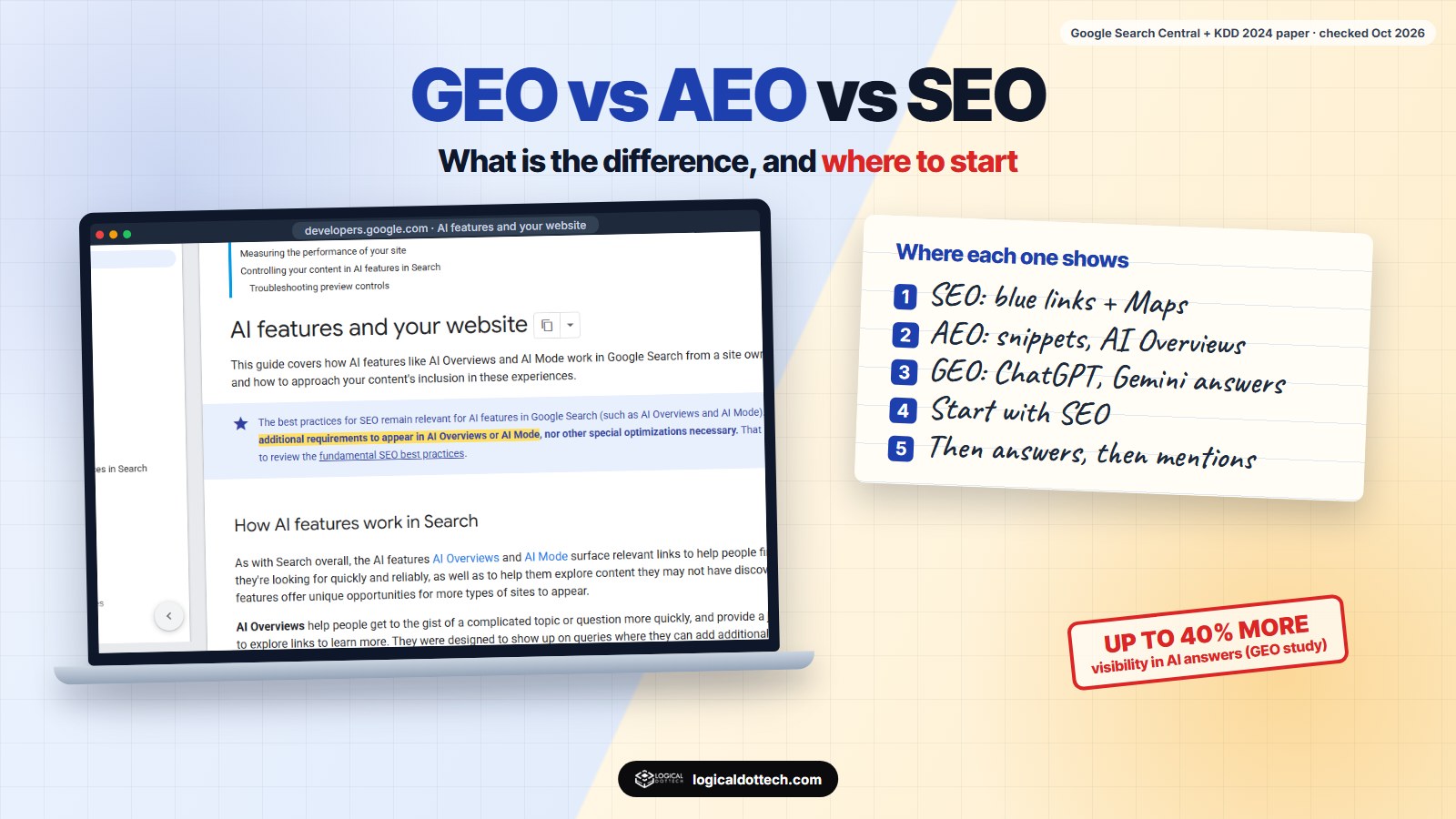
Short answer: SEO gets your page ranked in the normal search results. AEO (answer engine optimization) gets your page used as the direct answer: featured snippets, People Also Ask, voice results and AI Overviews. GEO (generative engine optimization) gets your business named and cited inside answers written by AI tools such as ChatGPT, Gemini and Perplexity. They build on each other, in that order, and SEO is still the base: Google says there is no special optimization needed for its AI features.
We sell all three, so we get asked this every week. Our view: the three names describe three places your customer can meet you, not three separate jobs. This guide explains each one in plain words, shows what the research and Google itself say, and shares our own numbers, including where our pages do not rank yet. Sources were checked on 26 October 2026.
GEO vs AEO vs SEO at a glance
| SEO | AEO | GEO | |
|---|---|---|---|
| Goal | Rank your page in the results | Be the answer shown above or instead of the results | Be named or cited inside an AI-written answer |
| Where it shows | Google and Bing blue links, Maps | Featured snippets, People Also Ask, voice, AI Overviews | ChatGPT, Gemini, Perplexity, Google AI Mode, Copilot |
| Unit of work | A keyword and its page | A question and its 40 to 60 word answer | Your business, its facts and who mentions it |
| Main signals | Relevance, links, page quality, speed | Clear question headings, short direct answers, tables | Citations, quotes, statistics, mentions on other sites, consistent facts |
| How you measure it | Rankings, clicks, leads in Search Console | Snippets and question searches you hold | How often AI answers name you for a fixed list of prompts |
What is SEO?
Search engine optimization is the work of making a page easy for search engines to crawl, understand and trust, so it ranks for the searches your customers type. It covers technical health (speed, mobile, indexing), the content of each page, internal links, and links and mentions from other sites. For a local business it also covers the Google Business Profile, which decides most Maps results.
What is AEO?
Answer engine optimization is SEO aimed at the answer slots. When someone asks a question, Google often shows one answer before any blue link: a featured snippet, a People Also Ask box, or an AI Overview. AEO means writing each page so a search engine can lift a clear answer from it: the question as a heading, a direct answer right under it, then the detail. We explain it in full in What is AEO? Answer engine optimization explained.
What is generative engine optimization (GEO)?
Generative engine optimization is the work of getting your business into answers that an AI tool writes for the user. The term comes from a research paper, “GEO: Generative Engine Optimization” by Pranjal Aggarwal of IIT Delhi with researchers from Princeton University, accepted to KDD 2024. They built a benchmark of 10,000 search queries, tested nine ways of editing web pages, and measured how visible each page became in the AI-written answer.
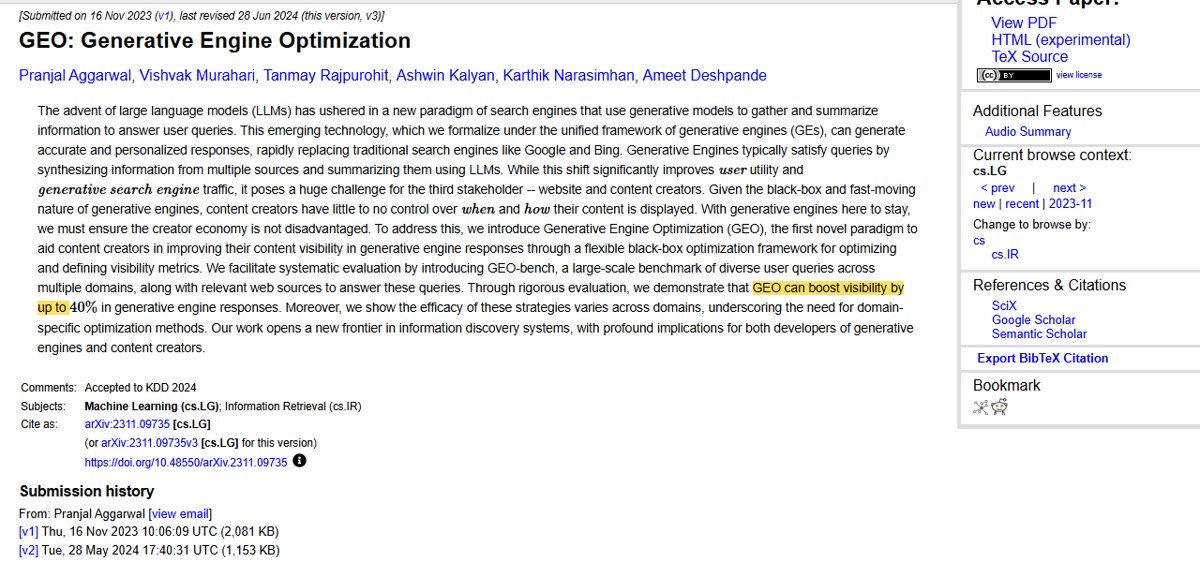
The results, from Table 1 of the full paper (visibility score, where the unedited page scored 19.5):
| Change made to the page | Visibility score | Against no change |
|---|---|---|
| Adding quotations from credible sources | 27.8 | About 42% higher |
| Adding statistics | 25.9 | About 33% higher |
| Making the text read more fluently | 25.1 | About 29% higher |
| Citing sources | 24.9 | About 28% higher |
| Stuffing in more keywords | 17.8 | About 9% lower |
Two findings matter most for small businesses. First, keyword stuffing, an old SEO habit, made pages less visible. Second, pages that ranked lower in normal search gained the most: citing sources raised visibility by 115.1% for websites ranked fifth, while the top-ranked site lost 30.3% on average. The authors also note that what works varies by topic, so treat these numbers as direction, not a formula.
What does Google say about optimizing for AI?
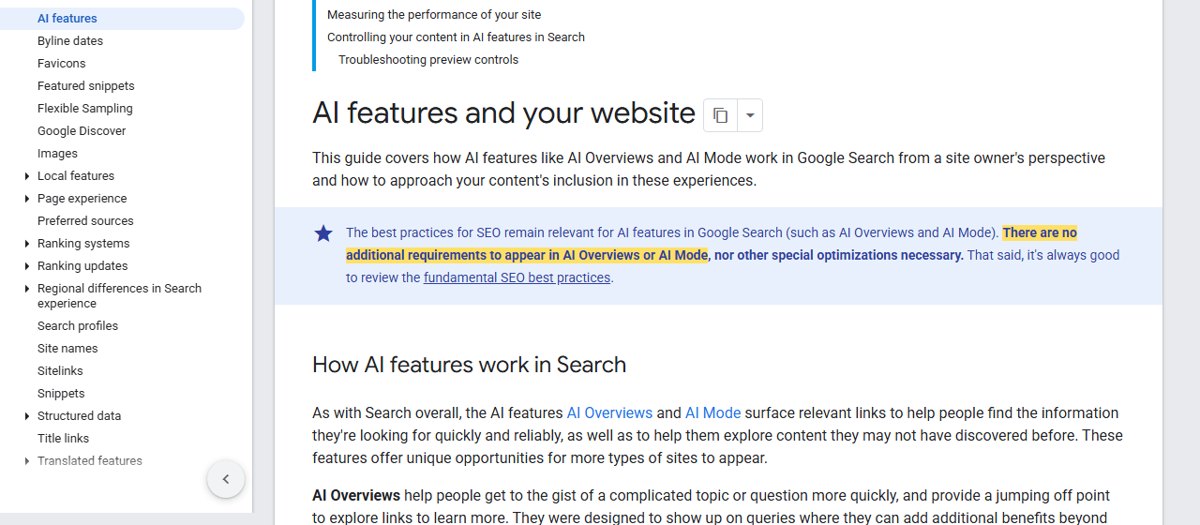
Google’s own page, AI features and your website, is clear: “There are no additional requirements to appear in AI Overviews or AI Mode, nor other special optimizations necessary.” It adds that you do not need new machine readable files, AI text files or markup, and that there is no special schema.org structured data to add.
Traffic from AI Overviews and AI Mode is counted inside the normal Performance report in Search Console, under the Web search type. There is no separate AI report, so you cannot see it on its own there.
Our reading: for Google, GEO and AEO are SEO done well. For ChatGPT, Perplexity and the rest, the same page quality matters, but they also lean on what other sites say about you, which is where GEO adds real work.
Generative engine optimization vs SEO: what actually changes?
- Mentions count more than links. An AI tool building a shortlist reads reviews, directories, news and comparison articles. Being named there matters even without a link.
- Facts must match everywhere. Name, services, location and prices that differ between your site, Google profile and listings make AI tools less sure about you.
- Evidence beats adjectives. Quotes, numbers and named sources made pages more visible in the GEO study. “Best service in town” does nothing.
- Crawlers must be allowed in. OpenAI says sites that block OAI-SearchBot “will not be shown in ChatGPT search answers”. Check your robots.txt and your hosting firewall.
- Clicks get rarer. Pew Research found that Google users clicked a normal result in 8% of visits when an AI summary appeared, against 15% without one. Being named in the answer is worth more than ranking below it.
Our own numbers
We publish our data, including the parts that do not look good. In Google Search Console for the 90 days to 22 October 2026:
| Our page | Impressions | Average position |
|---|---|---|
| /aeo/ (AEO services) | 181 | 25 |
| /geo/ (GEO services) | 88 | 71.6 |
| Search “geo optimization” | 35 | 89.5 |
| Search “aeo services” | 73 | 29 |
Two lessons. The GEO searches are crowded by large sites that have covered the term for longer, so our page sits far back. And our pages were shown for searches they did not answer: people searched “geo optimization”, and the page talked only about our service. That is why we wrote this comparison, and why we rewrote our AEO page on 25 October to answer “aeo services” directly. We will add the results to this article.
Which one should a small business start with?
- SEO basics. The site loads fast on a phone, every page can be indexed, each service has its own page, and your Google Business Profile is complete.
- AEO on your main pages. Put the real questions customers ask as headings, answer each in two or three sentences, then add the detail and a table where it helps.
- Consistent facts. The same name, address, phone, services and hours on your site, Google profile and every directory.
- GEO evidence. Add your own numbers, quotes from real customers with permission, and sources for every claim.
- Mentions. Get listed on the directories and comparison pages AI tools read for your industry, and ask happy customers for reviews.
- Check. Keep a list of 10 to 20 customer questions and ask ChatGPT, Gemini and Perplexity every few weeks. Note who gets named.
Our guide How to get your business recommended by ChatGPT walks through the checking step in detail.
If you would rather have this done for you, see our GEO services, AEO services and AI SEO services. Book a free 30-minute call and we will tell you which of the three your site needs first.
Common questions
Is GEO replacing SEO?
No. Google says the SEO basics still apply to its AI features, and AI tools that search the web pick their sources from pages that are crawlable, clear and trusted. GEO adds work on top of SEO; it does not replace it.
Is AEO the same as GEO?
They overlap but aim at different places. AEO is about being the direct answer in featured snippets, People Also Ask, voice results and AI Overviews. GEO is about being named and cited inside answers written by ChatGPT, Gemini, Perplexity and Google AI Mode. Most of the work, such as clear answers and consistent facts, helps both.
Do I need an llms.txt file or special schema for AI search?
Not for Google. Its AI features page says you do not need new machine readable files, AI text files or markup, and that there is no special schema.org structured data to add. Other AI companies set their own rules, so check the documentation of each before spending time on special files.
How do I know if ChatGPT or Gemini mentions my business?
Ask them the questions your customers ask, in a logged-out or private window, and note which businesses they name and which pages they cite. Repeat the same list every few weeks, because answers change.
Can I block AI crawlers and still appear in AI answers?
It depends on which crawler. OpenAI says sites that block OAI-SearchBot will not be shown in ChatGPT search answers, while GPTBot is used for training its models. Blocking the training crawler and allowing the search crawler is a common choice.
Which one should a small business start with?
SEO first, because a page that cannot be found or crawled will not be cited anywhere. Then rewrite your main pages so each one answers its question in the first lines (AEO), and then work on mentions and listings on other sites (GEO).
Sources checked on 26 October 2026: Google Search Central, AI features and your website (last updated 10 December 2025), Aggarwal et al., GEO: Generative Engine Optimization, KDD 2024, OpenAI, Overview of OpenAI crawlers and Pew Research Center, 22 July 2025. Search Console figures are our own, for logicaldottech.com, 90 days to 22 October 2026.