
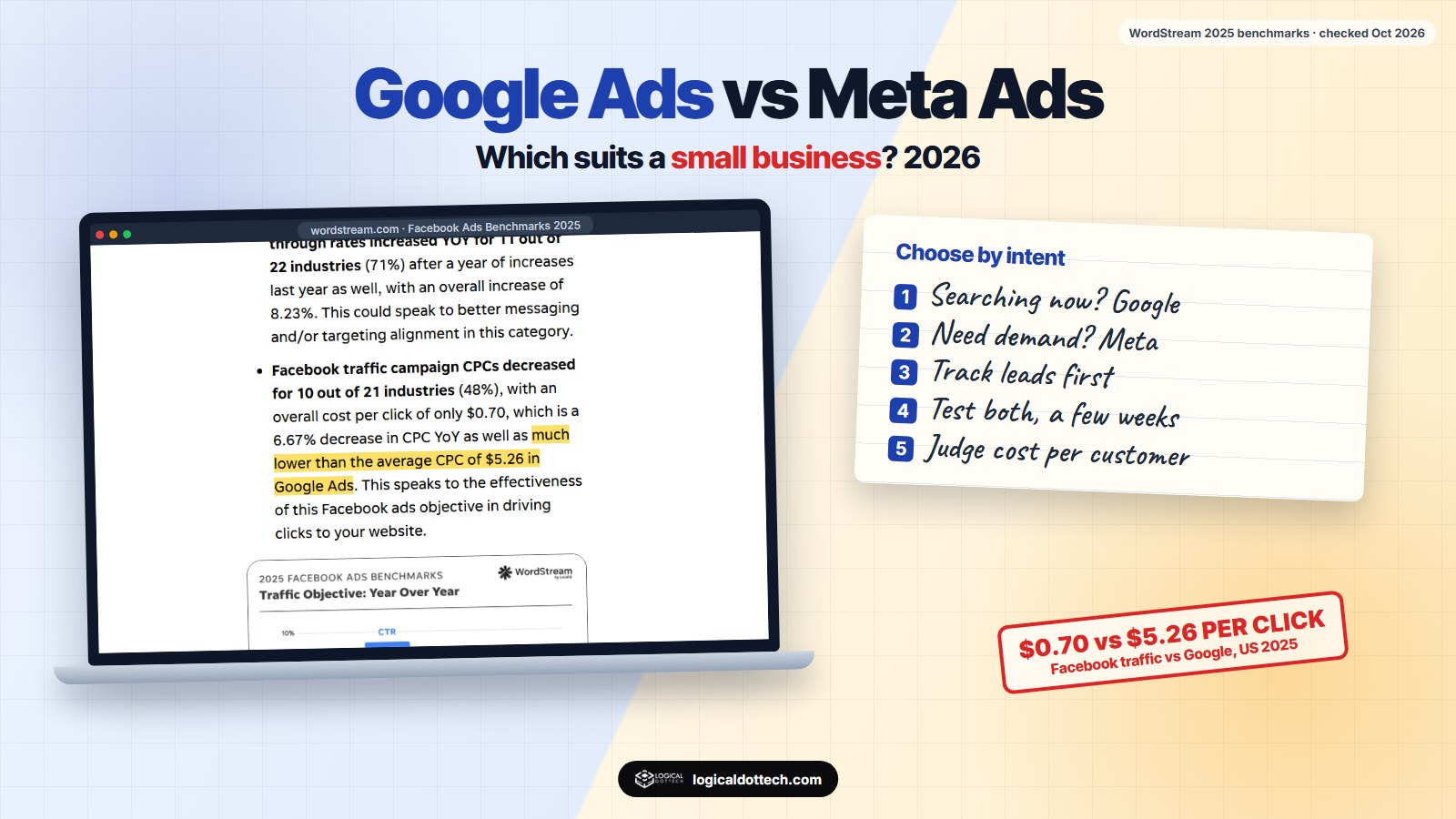
Short answer: use Google Ads when people already search for what you sell, because you reach them at the moment they need it. Use Meta ads (Facebook and Instagram) when you need to create demand or reach people by interest and location, because clicks cost far less. In WordStream’s 2025 US data, a Facebook traffic click averaged $0.70 against $5.26 on Google. Compare platforms by cost per lead or sale, not cost per click.
We run both Google and Meta campaigns for small businesses, and the honest answer to “which is better?” is “for what?”. This guide explains the difference, shows real benchmark numbers, and ends with a simple way to test both. Figures are from WordStream and LocaliQ’s 2025 Facebook ads benchmarks, read in full on 20 October 2026.
Google Ads vs Meta Ads at a glance
| Google Ads (Search) | Meta Ads (Facebook, Instagram) | |
|---|---|---|
| You reach people who | Are searching for it right now | Match an interest, age, location or a customer list |
| Best for | Urgent or planned needs: repairs, clinics, services, “near me” | New products, food, fashion, events, courses, local offers |
| Cost per click | Higher | Lower |
| What the ad looks like | Mostly text in search results | Images, video, reels, carousels |
| Lead form inside the platform | Lead form assets | Lead Ads, widely used |
| Main risk | Paying for broad or irrelevant searches | Cheap but low-quality leads |
What do the benchmarks say?
WordStream and LocaliQ’s 2025 Facebook ads benchmarks looked at 554 US traffic campaigns and 726 US lead campaigns that ran between 1 April 2024 and 30 June 2025:
| Facebook ads, all industries | Traffic campaigns | Lead campaigns |
|---|---|---|
| Average cost per click | $0.70 | $1.92 |
| Average click-through rate | 1.71% | 2.59% |
| Average conversion rate | (not reported) | 7.72% |
| Average cost per lead | (not reported) | $27.66, up from $22.87 |
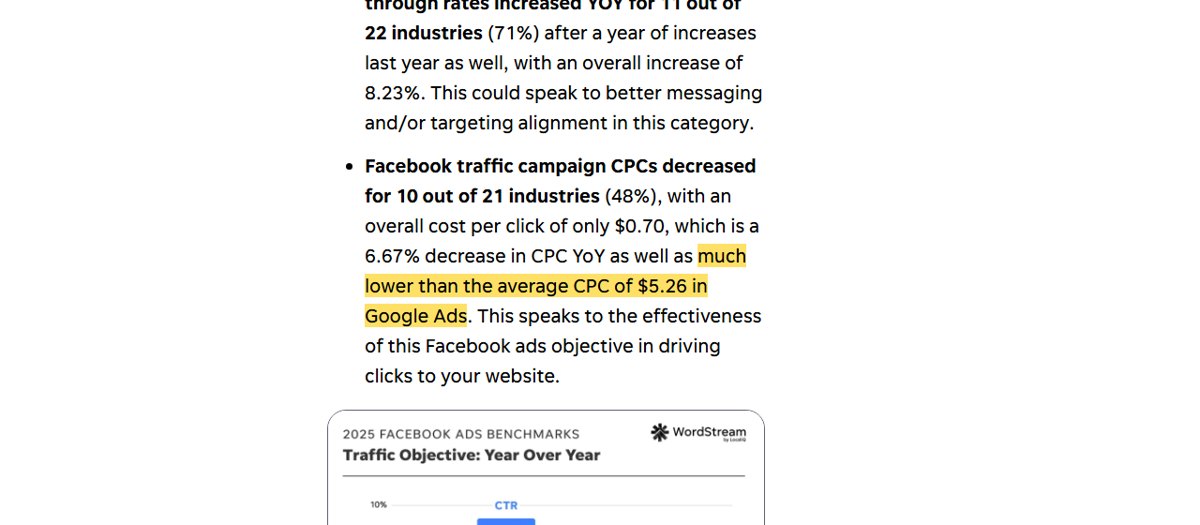
The same report compares this with Google: the $0.70 Facebook traffic CPC is “much lower than the average CPC of $5.26 in Google Ads”.
Costs vary a lot by industry. For Facebook lead campaigns, cost per lead ranged from $3.16 for restaurants and food to $76.71 for dentists and dental services.
Two cautions before you use these numbers. They are US figures, and click costs differ a lot from country to country, including in India. And a cheap click is not a cheap customer: a Google searcher who typed “AC repair near me” is often closer to buying than someone who tapped an Instagram ad while scrolling.
When does Google Ads win?
- People search for your service when they need it. Plumbers, clinics, lawyers, repair shops, B2B services.
- The need is urgent. “Emergency dentist”, “laptop repair today”.
- The sale is worth a higher click cost. A single client covers many clicks.
- You serve a clear area. Location targeting and call ads put you in front of nearby searchers.
When do Meta ads win?
- Few people search for it yet. A new product, a new cafe, a workshop.
- It sells on looks. Food, fashion, home decor, travel, events.
- You want reach in a town or neighbourhood at low cost, for openings and offers.
- You have a customer list or website visitors to retarget.
How to test both with a small budget
- Pick one offer. One service or product, one price or free consultation, one landing page that matches the ad.
- Set up tracking first. Google Analytics, the Meta pixel, and conversion tracking for calls, forms and WhatsApp clicks. Without it, you are comparing guesses.
- Google: one search campaign with a few tight keyword groups, phrase and exact match, a negative keyword list, and location targeting.
- Meta: one campaign with the leads or traffic objective, two or three creatives, and a location radius around you.
- Run both for a few weeks, then compare cost per lead and, more importantly, how many leads became customers.
- Move budget to the winner, and keep a small amount on the other to keep learning.
See what your competitors are running
Both platforms publish ads for anyone to see. Search a competitor in Google’s Ads Transparency Center and Meta’s Ad Library to see their current ads, offers and formats. Ads that have run for months are often the ones that work.
Common mistakes
| Mistake | What to do instead |
|---|---|
| Judging by cost per click | Judge by cost per lead and per customer |
| Sending ad clicks to the home page | A landing page that matches the ad and offer |
| Google broad match with no negative keywords | Tight keywords, and add negatives every week |
| Meta lead forms with no follow-up within the hour | Call or WhatsApp new leads quickly |
| No conversion tracking | Set it up before spending |
If you would like help, see our Google Ads management, Meta Ads management and PPC management services. Book a free 30-minute call and we will suggest which platform to test first for your business.
Common questions
Which is better for a small business, Google Ads or Facebook Ads?
It depends on whether people already search for what you sell. If they do (a plumber, a dentist, a website designer), Google Ads catches them at the moment of need. If they do not search for it yet (a new product, a cafe, a course), Meta ads on Facebook and Instagram create the demand. Many businesses run both with a small test budget first.
Are Facebook ads cheaper than Google Ads?
Per click, usually yes. WordStream and LocaliQ’s 2025 benchmarks for US advertisers put the average Facebook traffic campaign CPC at $0.70, against an average Google Ads CPC of $5.26. A cheaper click is not the same as a cheaper customer, so compare cost per lead or sale.
How much should a small business spend on ads to test?
Enough to get meaningful data, usually a few weeks of spend that brings at least a few dozen clicks or several leads per ad group. Start with one campaign per platform, one clear offer, and a landing page that matches the ad.
Do these benchmark numbers apply in India?
No, not directly. The WordStream figures come from US campaigns. Click costs and the value of each sale in India differ from the US, industry by industry. Use benchmarks to understand the gap between platforms, then judge by your own cost per lead.
How can I see my competitors’ ads?
Both platforms publish them. Google’s Ads Transparency Center and Meta’s Ad Library let anyone search an advertiser and see the ads they are running, which is a free way to learn what works in your market.
Should I use Google Local Services Ads instead?
If your business type is eligible in your country, Local Services Ads charge per lead and show above normal ads. They suit service businesses such as roofers or plumbers. Check eligibility in your country first.
Sources checked on 20 October 2026: WordStream and LocaliQ, Facebook Ads Benchmarks 2025 (US campaigns, 1 April 2024 to 30 June 2025), Google Ads Transparency Center and Meta Ad Library. Benchmarks are averages across many advertisers; your own costs will differ by country, industry and offer.