
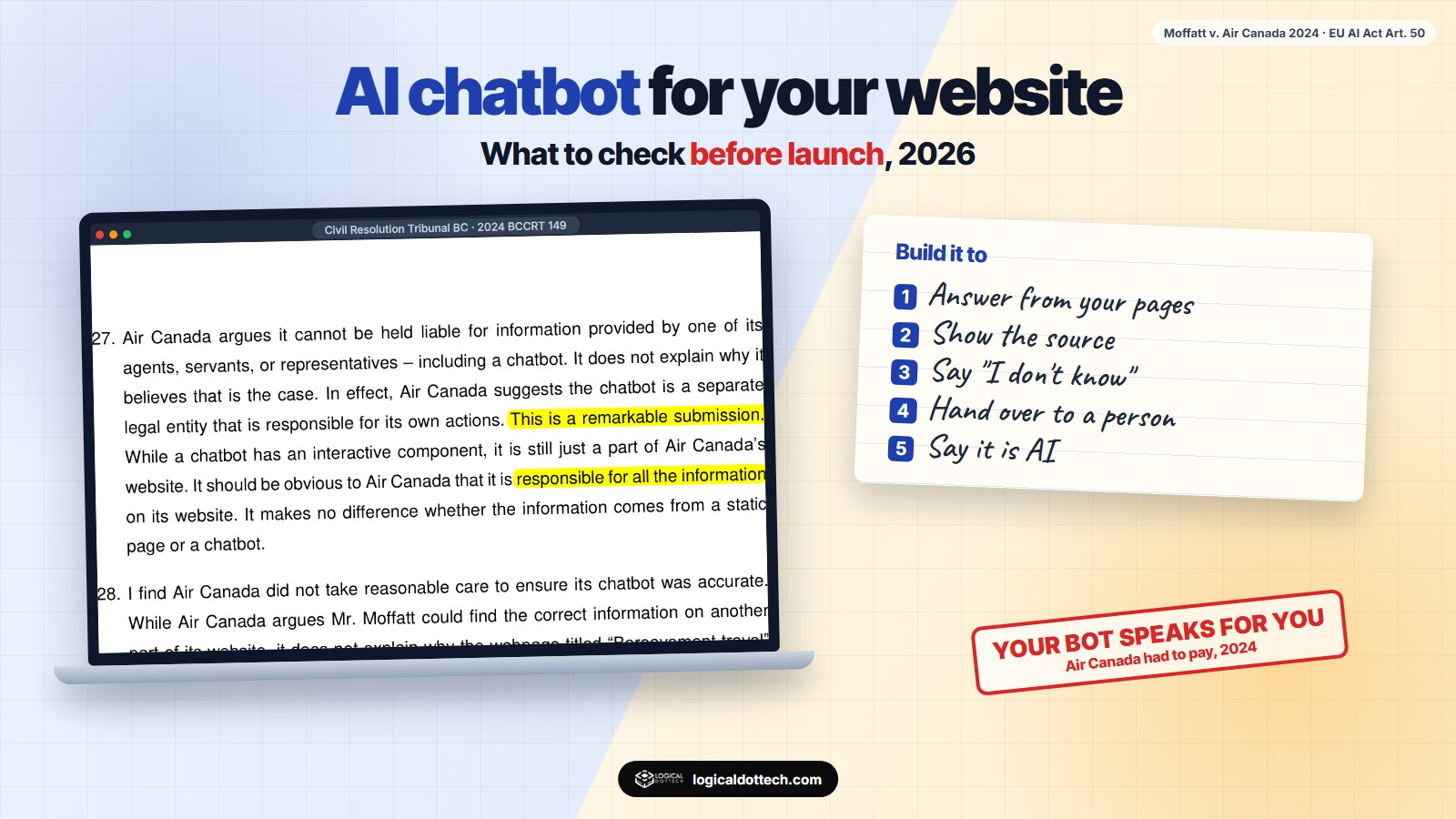
Short answer: an AI chatbot on your website can answer common questions, capture leads and book appointments around the clock, but whatever it says, your business says. In Moffatt v. Air Canada (2024), a tribunal made the airline pay for its chatbot’s wrong answer. So build it to answer only from your approved content, show sources, say “I don’t know” instead of guessing, hand over to a person, and tell visitors it is AI, which EU law requires from August 2026.
We build AI chatbots for business websites. Most of the work is not the AI itself but making sure it never tells a customer something you would not put in writing. This guide covers the one court case every business owner should know, the EU disclosure rule, and a launch checklist. Sources were checked on 20 October 2026.
What can a website chatbot do for a business?
| Good jobs for a chatbot | Keep with a person |
|---|---|
| Opening hours, location, delivery areas | Refunds and exceptions to policy |
| “Which service do I need?” guidance from your pages | Price negotiations and custom quotes |
| Order and booking status | Complaints |
| Collecting name, need and contact for a callback | Medical, legal or financial advice |
| Booking or requesting an appointment | Anything the bot is unsure about |
The Air Canada case: your chatbot speaks for you
In November 2022, Jake Moffatt asked Air Canada’s website chatbot about bereavement fares after his grandmother died. The chatbot said he could apply for the discount after travelling. The airline’s own policy page said otherwise, and Air Canada refused the refund. It then argued in front of British Columbia’s Civil Resolution Tribunal that it could not be held liable for information from its chatbot.
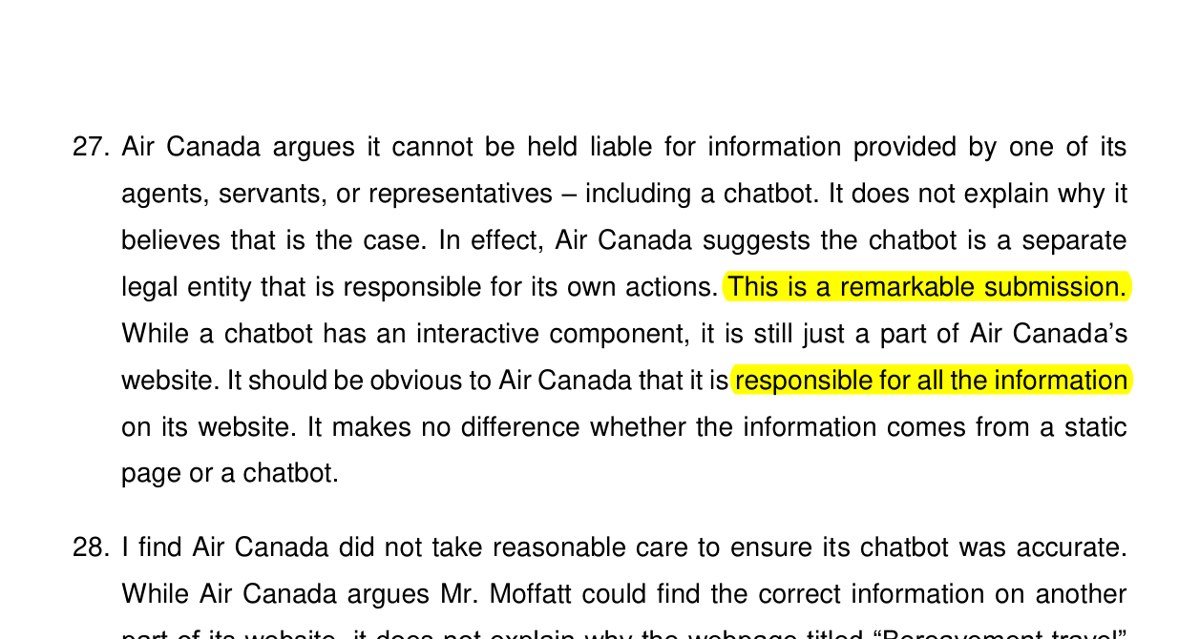
The tribunal called that “a remarkable submission”. It found the airline “did not take reasonable care to ensure its chatbot was accurate” and ordered it to pay $812.02 (Canadian), made up of $650.88 in damages plus interest and fees. It is a small-claims decision, not binding on other courts, but the point is simple: customers are entitled to trust what your website tells them, including the chatbot.
Do you have to tell people they are talking to AI?
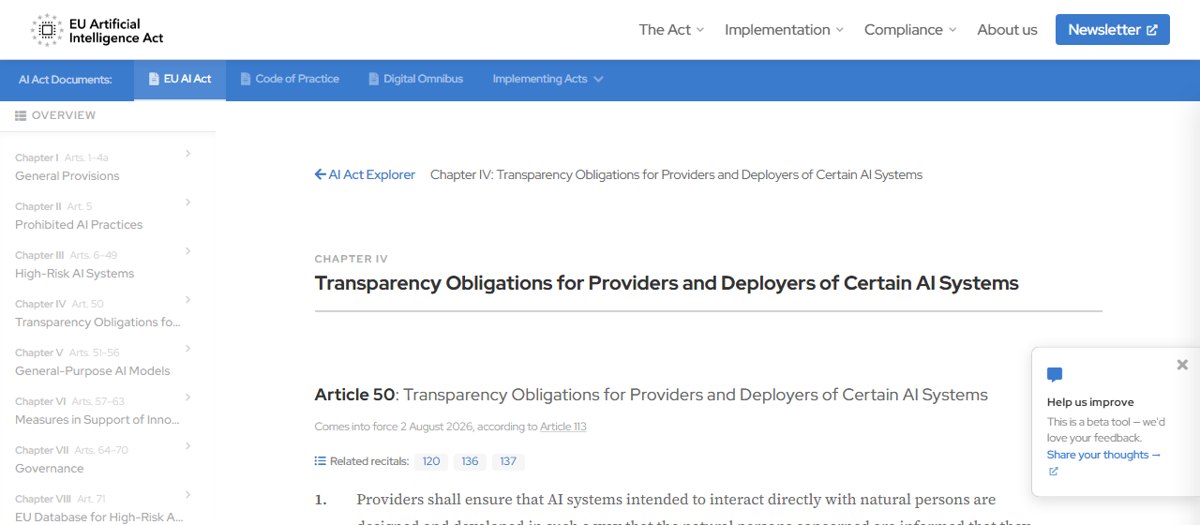
If you serve customers in the European Union, yes. Article 50 of the EU AI Act says providers must make sure people are informed that they are interacting with an AI system, unless that is obvious to a reasonably well-informed person. The official text applies this from 2 August 2026.
Outside the EU, do it anyway. A clear “AI assistant” label and a visible “talk to a person” button reduce angry chats when the bot gets something wrong.
How to build a chatbot you can trust
- Answer from your content only. Use retrieval-augmented generation (RAG): the bot looks up your approved pages and answers from them. We explain this in custom LLM vs ChatGPT API.
- Show the source. Link the page each answer came from, so customers and your team can check it.
- Let it say “I don’t know”. When no approved content matches, it should say so and offer a person, not guess.
- Keep it to your business. Refuse off-topic questions politely.
- Put policies in pages, not prompts. Prices, refund terms and conditions live on pages the bot quotes, so one update fixes both.
- Hand over cleanly. Pass the chat so far to a person by email, WhatsApp or your help desk, so the customer does not repeat themselves.
- Protect personal data. Collect only what you need, say how it is used, and follow privacy law such as India’s Digital Personal Data Protection Act, 2023 or the GDPR in Europe.
Launch checklist
| Check | How |
|---|---|
| Answers match your policy pages | Ask it the 50 most common real questions and compare |
| It refuses what it should | Ask about refunds outside policy, legal advice, competitors |
| It admits when it does not know | Ask about something not on your site |
| The AI label and “talk to a person” are visible | Check on a phone |
| Hand-over reaches a real person | Trigger it and time the reply |
| Leads are saved | Submit a test lead and find it in your inbox or CRM |
| Chats are reviewed | Read a sample every week and fix the content behind bad answers |
If you want an AI chatbot built this way for your website, see our AI chatbot development and AI agent services. For WhatsApp, read WhatsApp chatbot for business. Book a free 30-minute call and we will test a chatbot on your own content with you.
Common questions
Is my business responsible for what its chatbot says?
In the best-known case so far, yes. In Moffatt v. Air Canada (2024), a British Columbia tribunal held the airline responsible for wrong fare information from its website chatbot, saying a company is responsible for all the information on its website, whether it comes from a static page or a chatbot. It is a small-claims decision, but the reasoning is easy to follow.
Do I have to tell visitors they are talking to AI?
If you serve people in the EU, Article 50 of the EU AI Act requires that people are informed they are interacting with an AI system unless it is obvious, and the official text applies it from 2 August 2026. Elsewhere it is still good practice: label the bot and offer a person.
What should a website chatbot be able to do?
Answer common questions from your own content, point to the right page, collect a lead’s details, book or request an appointment, and hand over to a person. It should say “I don’t know” instead of guessing.
How do I stop a chatbot from making things up?
Make it answer only from your own approved content (retrieval-augmented generation), show the source page with each answer, refuse questions outside your business, and test it with real customer questions before launch. Keep prices, refunds and legal terms in pages it quotes, not in its “memory”.
Is a website chatbot better than WhatsApp?
They do different jobs. A website chatbot helps visitors who are already on your site. WhatsApp reaches people on their phones after they leave. Many businesses connect both to the same knowledge base.
How much does an AI chatbot cost to run?
The running cost is mostly the AI model usage per message plus hosting, which is small for most small businesses. The bigger cost is setting it up well: preparing your content, connecting your systems and testing. Ask for a fixed-scope first version.
Sources checked on 20 October 2026: Civil Resolution Tribunal of British Columbia, Moffatt v. Air Canada, 2024 BCCRT 149 (decision read in full) and EU AI Act, Article 50. This article is general information, not legal advice.