
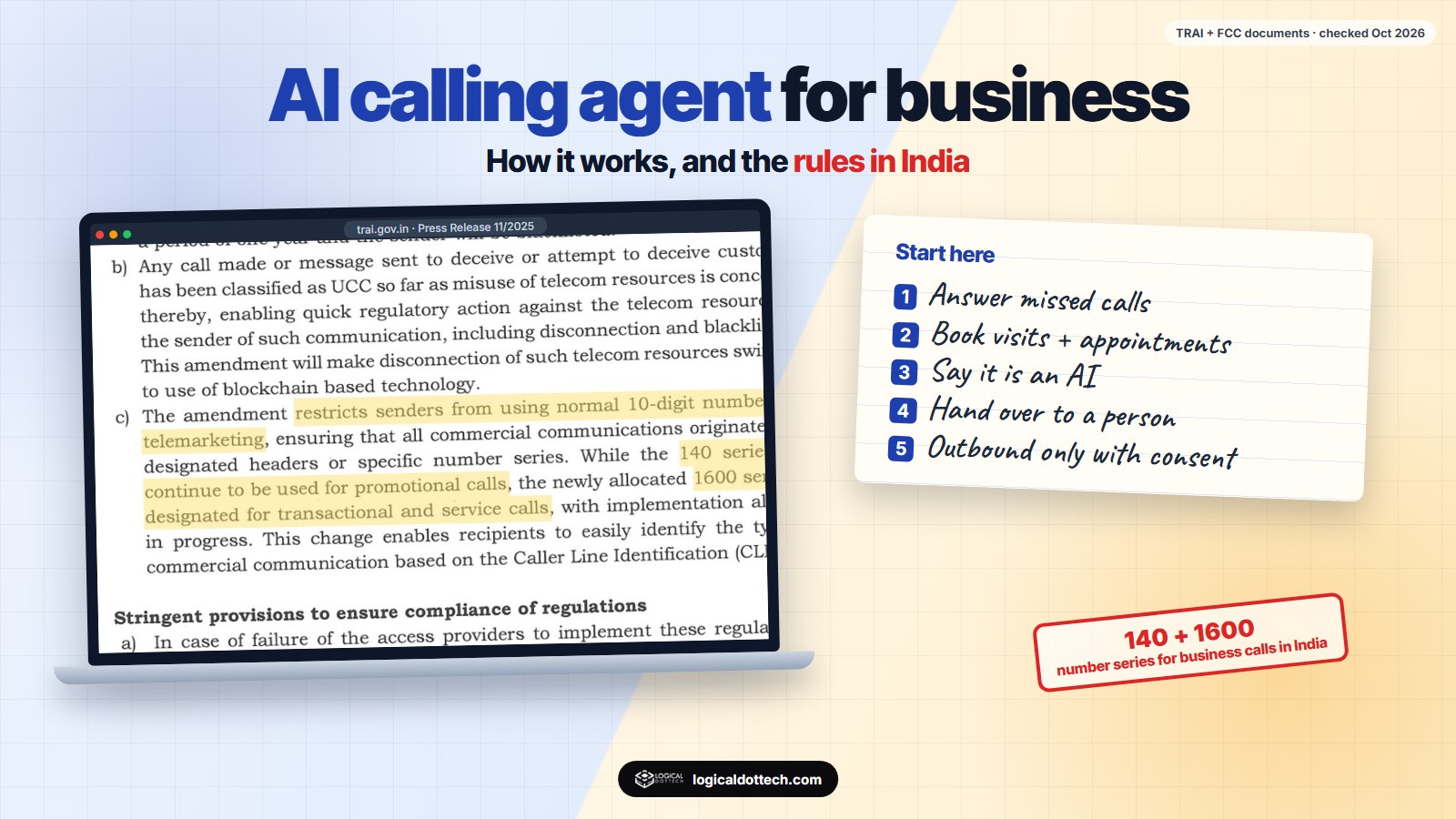
Short answer: an AI calling agent is software that answers or makes phone calls in a natural voice: it understands what the caller says, answers from your business information, books appointments and hands over to a person when needed. In India, answering calls customers make to you is simple. Calls you make are regulated by TRAI: promotional calls need consent and a 140-series number, service calls belong on the 1600 series, and normal 10-digit numbers must not be used for telemarketing.
Our view: start with the calls you already miss, not with cold calling. An agent that picks up every call after 7 pm and books the visit pays for itself faster, and it carries almost no regulatory risk. This guide explains how these agents work, what they can do, the rules in India and the US, and how to set one up. The rules were read in the original TRAI and FCC documents on 26 October 2026.
What is an AI calling agent?
It is a phone line connected to an AI model. When a call comes in, or when the agent places one, five parts work together:
| Part | What it does |
|---|---|
| Phone number | A number from a telecom or cloud phone provider that the agent answers or calls from |
| Speech to text | Turns what the caller says into text, in Hindi, English or both |
| AI model with your information | Decides the reply, using your services, timings, prices you choose to share and rules for what it must not say |
| Text to speech | Speaks the reply in a natural voice, fast enough to feel like a conversation |
| Connections | Calendar, CRM, WhatsApp or SMS, so the call ends with a booking, a lead record or a message |
The older version of this was the IVR menu (“press 1 for sales”). The difference is that the caller just talks, and the agent answers the actual question.
What can an AI calling agent do for a business?
- Answer every call, day and night. Timings, location, services, fees you choose to share, order status.
- Book appointments and site visits. It checks the calendar, books the slot and sends a confirmation on WhatsApp or SMS.
- Take enquiries properly. Name, need, budget, area and best time to call back, written into your CRM.
- Call back new enquiries fast. A person who just filled a form on your website or an ad can get a call within a minute, with their consent.
- Send reminders. Appointment, payment due or document pending, as service calls to existing customers.
- Hand over. Transfer the call or book a callback when the caller is upset, the question is outside its information, or they ask for a person.
Inbound or outbound: where should you start?
| Inbound (customers call you) | Outbound (your agent calls them) | |
|---|---|---|
| Typical use | Missed calls, after-hours calls, bookings, FAQs | Lead callbacks, reminders, feedback, promotions |
| Rules in India | Normal call handling | TRAI TCCCPR: consent, number series, registration |
| Risk | Low | High if promotional or without consent |
| Our advice | Start here | Add later, for service calls and leads who asked to be called |
What are the rules for AI calling in India?
Commercial calls in India are covered by the Telecom Commercial Communications Customer Preference Regulations (TCCCPR), 2018. TRAI amended them on 12 February 2025. From TRAI Press Release 11/2025:
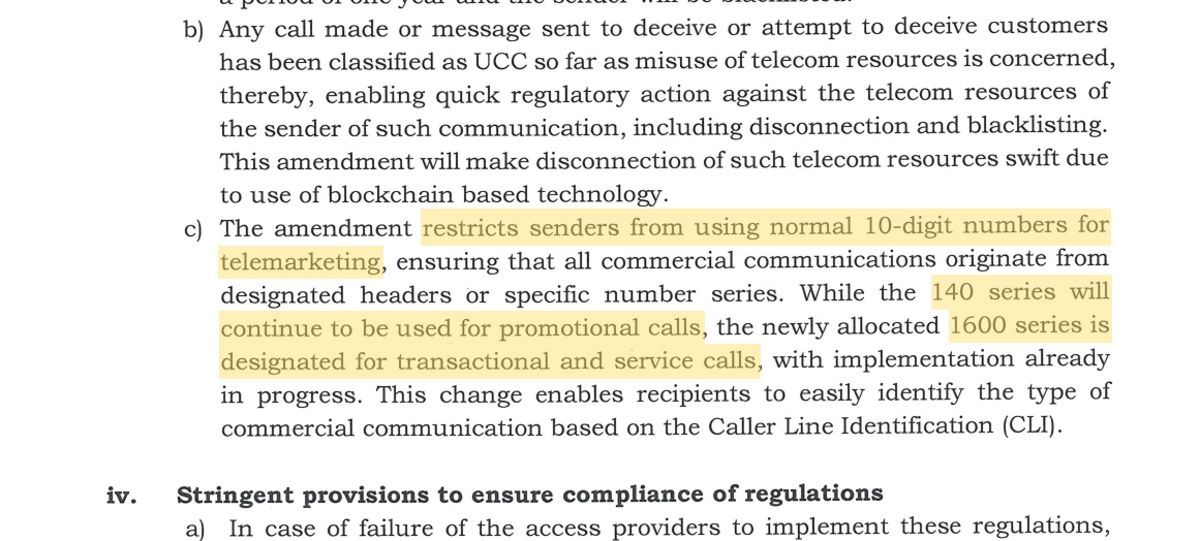
- No telemarketing from normal numbers. Senders may not use normal 10-digit numbers for telemarketing.
- 140 series for promotional calls, 1600 series for service and transactional calls. The regulation’s explanatory note adds that promotional auto-dialer or robo calls should go through 140-series numbers only, and service or transactional robo calls through the 1600 series.
- Robo calls must be disclosed. The amendment “brings in disclosure of the use of auto-dialers/ robo calls”.
- Consent has limits. Consent given for an ongoing transaction is valid for 7 days. Implicit consent for service calls lasts only while the contract with the customer lasts. A customer who opted out cannot be asked for consent again for 90 days.
- Penalties are real. For a first violation, the sender’s outgoing services are barred for 15 days. For later violations, all of the sender’s telecom resources are disconnected across all providers for a year and the sender is blacklisted.
The full text is in the TCCCPR (Second Amendment) Regulations, 2025. Separately, India’s Digital Personal Data Protection Rules, 2025 were notified in November 2025, and most of their duties on notice, consent and security apply from May 2027, according to a Delhi government office memorandum on the rules. Call recordings and transcripts hold personal data, so plan for consent and deletion now.
This is a summary to help you plan, not legal advice. For outbound calling, check the exact registration your use case needs with your telecom provider.
What are the rules in the US?
On 8 February 2024 the US Federal Communications Commission released Declaratory Ruling FCC 24-17. It confirms that the Telephone Consumer Protection Act’s limits on “artificial or prerecorded voice” calls cover AI-generated voices.
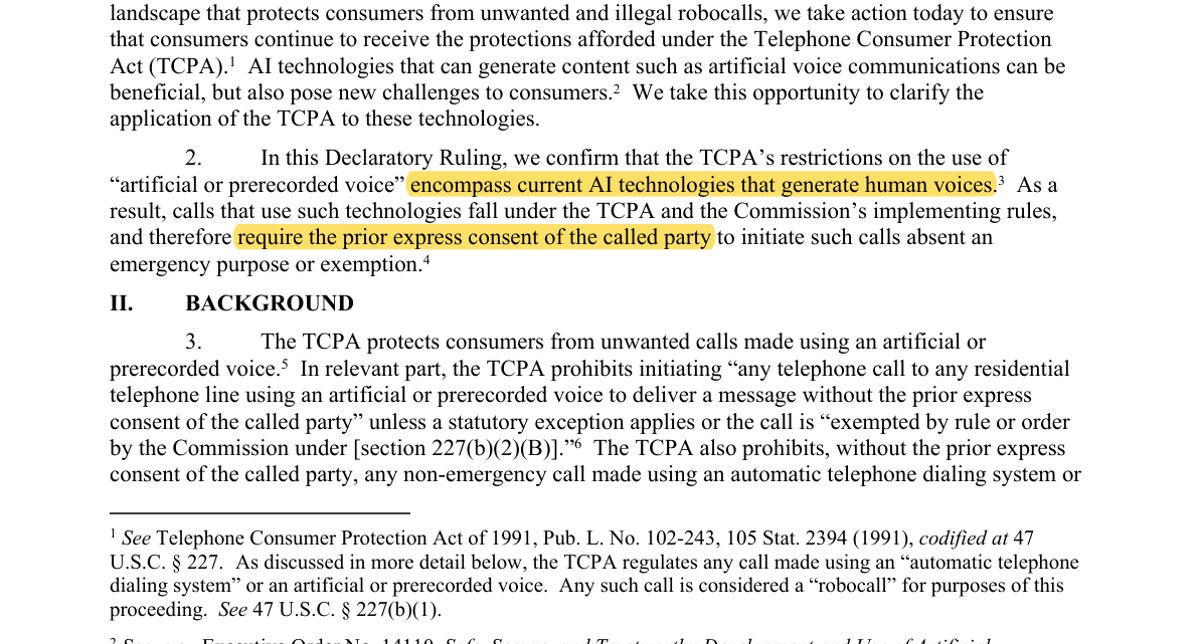
In practice: an AI voice calling a US consumer needs the person’s prior express consent, unless it is an emergency or an exemption applies, and the message must identify the business making the call. Inbound calls that customers place to your AI receptionist are a different matter, though you should still say it is an AI.
AI calling agent for real estate: a good first use
Property enquiries are a strong fit, because leads arrive at all hours from portals, ads and your website, and a fast callback reaches the buyer while they are still looking at the listing. A setup we would build:
- Enquiry arrives from your website form or ad lead form, with consent to be called.
- The agent calls back within a minute and says who it is and that it is an AI assistant.
- It qualifies the lead: budget, area, flat size, timeline, loan needed or not.
- It books a site visit in your sales team’s calendar and sends the location on WhatsApp.
- It writes everything into your CRM and alerts a salesperson for hot leads.
What we would not build: cold calls to bought number lists. That is exactly what TRAI’s rules and penalties target.
What decides the cost?
We do not publish prices, because two agents can be very different jobs. These are the things that move the cost:
- Call minutes: you pay for phone minutes and for AI usage per minute, so volume and call length matter most.
- Number type: a normal business number for inbound, or registered 140 or 1600 numbers for outbound.
- Languages: English only, Hindi, Hinglish or regional languages.
- Connections: calendar, CRM, WhatsApp, payment links or your own software.
- Recording and storage: how long recordings and transcripts are kept, and where.
- Testing and tuning: the first weeks of reading transcripts and fixing answers.
How to set up an AI calling agent
- Pick one call type. For example, after-hours calls for a clinic or site-visit bookings for a builder.
- Write the information it may use. Services, timings, location, fees you are happy to share, and what it must never say.
- Write the handover rules. When it must transfer the call or book a callback.
- Get the number right. Forward missed calls to the agent for inbound; for outbound, sort out the number series and registration first.
- Test with real voices. Fifty test calls in the accents and noise your customers have.
- Launch small. After-hours first, then busy hours once the transcripts look good.
- Read transcripts every week. Fix wrong answers and add the questions it could not answer.
What to check before you buy one
| Check | Why it matters |
|---|---|
| Hindi and Hinglish on real recordings | Demos use clean audio; your callers will not |
| Delay before each reply | More than a second or two feels broken on a phone call |
| Transfer to a person | Every agent meets questions it cannot answer |
| Transcripts and recordings you can read | The only way to see what it is telling customers |
| Where call data is stored and for how long | Personal data duties under India’s DPDP rules |
| Says it is an AI and offers opt-out | Honest, and in line with TRAI and FCC direction |
We build AI voice agents that answer calls, book appointments and send each call summary to your team, and connect them with business automation for follow-ups. If your customers prefer typing, see our guide to a WhatsApp chatbot for business. Book a free 30-minute call and we will tell you which calls are worth handing to an agent first.
Common questions
Is it legal to use an AI calling agent in India?
Yes, with conditions. An AI agent answering calls your customers make to you is ordinary call handling. Calls your business makes are commercial communication under TRAI’s TCCCPR rules: promotional calls need consent and must come from 140-series numbers, service and transactional calls belong on the 1600 series, and normal 10-digit numbers must not be used for telemarketing.
Do I need a 140 or 1600 number for an AI calling agent?
For inbound calls, no; customers call your normal number. For outbound calls, TRAI’s 2025 amendment says promotional calls use the 140 series and service or transactional calls use the 1600 series. Ask your telecom provider which number series and registration your outbound use case needs before launch.
Can an AI calling agent speak Hindi?
Most current voice platforms handle Hindi and English, and many handle Hinglish. Accents, background noise and local words still trip them up, so test with recordings of your own customers before going live.
Should the AI tell callers it is an AI?
We recommend it, in the first sentence. TRAI’s 2025 amendment brings in disclosure of auto-dialer and robo calls, and in the US the FCC treats AI-generated voices as artificial voices that need prior express consent and identification. It also saves the awkward moment when a caller works it out halfway through.
Can it book appointments into my calendar?
Yes. The agent can check free slots in Google Calendar or a booking tool, book the slot, and send a confirmation by SMS or WhatsApp. The same link can update your CRM with the caller’s details.
Is there a free AI calling agent?
Several platforms give free trial minutes, and there are open-source projects on GitHub. For real business calls you still pay for phone minutes and AI usage, plus the time to set it up and check transcripts.
Sources checked on 26 October 2026: TRAI Press Release No. 11/2025 (12 February 2025), TCCCPR (Second Amendment) Regulations, 2025, FCC Declaratory Ruling 24-17 (released 8 February 2024) and Government of NCT of Delhi office memorandum on the DPDP Rules, 2025. This article explains the rules in plain words and is not legal advice.